 Chunlei Mining Machinery
5 Types of Glass Crushers Detailed
Glass is an indispensable material in our lives—from building doors and windows, car windshields, beer and beverage bottles, to mobile phone screens, it’s everywhere. However, the recycling and processing of waste glass has always been a major challenge for recycling companies.
Manual glass sorting is not only inefficient and costly, but also poses health risks. Therefore, a suitable glass crusher can not only improve the glass breakage rate but also transform waste glass into a profitable resource.
As someone who has worked in the crushing and screening industry for many years, I know how difficult it is to choose the right equipment. In this article, I will combine my extensive experience and understanding of various equipment parameters to discuss five mainstream types of glass crushers to help you find the most suitable crusher for your needs.
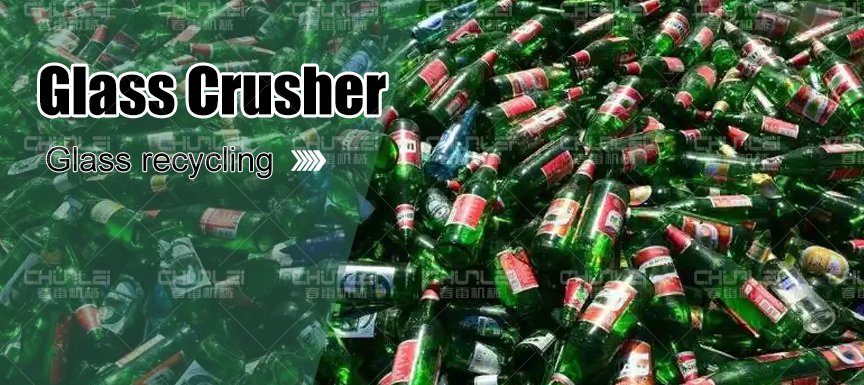
Jaw Crusher: The “Tough Guy” in the Coarse Crushing Stage
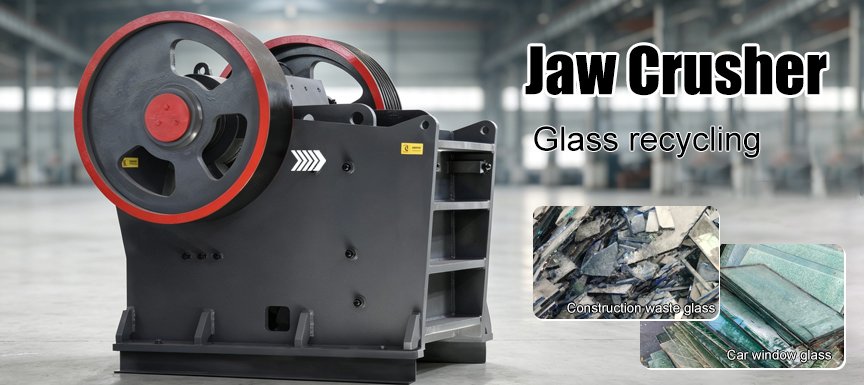
If you’re dealing with solid car window glass, thick architectural glass, or construction waste mixed with reinforced concrete, then a jaw crusher is the best choice.
My Real Experience:
My impression of jaw crushers is that they are “robust and durable.” They mimic the upper and lower jaws of an animal, using a moving jaw plate to periodically crush a fixed jaw plate to “crush” the glass. For applications with large throughput and high material hardness, a jaw crusher is the absolute first choice.
Advantages:
It has a large feed opening, capable of handling large pieces of material, and a high crushing ratio. I recently visited a friend’s recycling station where he used a small PE-150×250 jaw crusher to process recycled car windows. It could process 1-3 tons per hour, roughly 1500 to 5000 bottles, and the results were very noticeable.
Disadvantages:
The jaw plates are wear parts and wear out relatively quickly. Operators must constantly monitor the output particle size. If the particle size becomes coarse, the discharge port must be adjusted immediately, otherwise it will affect subsequent processes.
Applicable scenarios:
Primary crushing in bars, restaurants, hotels, and recycling centers, or as the first step in large-scale glass recycling production lines.
| Model | Maximum Feed Particle Size (mm) | Discharge Port Range (mm) | Processing Capacity (t/h) | Reference Number of Bottles Processed (bottles/hour) |
| PE-150×250 | 125 | 10-40 | 1-3 | 1,500-5,000 |
| PE-200×300 | 180 | 15-50 | 2-6 | 3,000-10,000 |
| PEX-150×750 (Fine Crushing) | 120 | 18-48 | 8-25 | 8,000-40,000 |
| PEX-250×750 (Fine Crushing) | 210 | 25-60 | 13-35 | 12,000-55,000 |
Hammer Crusher: The “Quick Gunner” of Glass Sand
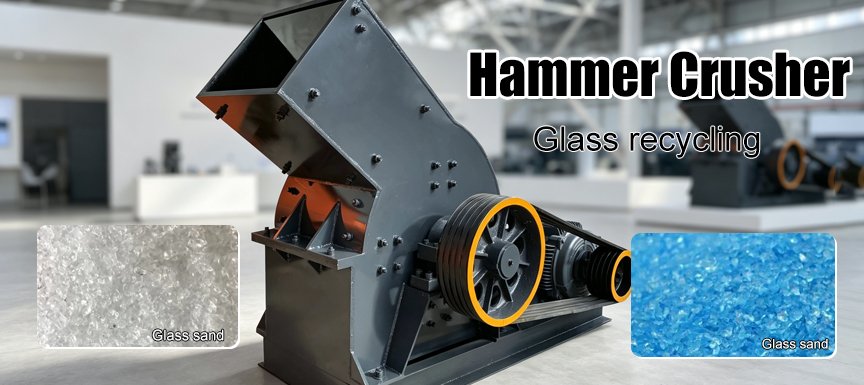
If you want to make glass sand, a hammer crusher is the best choice. It can crush glass bottles of various colors into uniform sand particles in one pass.
My Real Experience:
I remember a customer who makes artificial quartz stone slabs needed glass sand as filler. He originally used a combination of jaw crusher and impact crusher, but the cost was too high. Later, he switched to a PCΦ600×400 hammer crusher. The raw material was processed in one pass, and the output particles were fine, cubic, and well-shaped, with less over-crushing. He told me that this machine saved him a lot of trouble.
Advantages:
One-pass molding, no need for secondary crushing. The coarseness of the output sand can be precisely controlled by adjusting the grate gap at the discharge port, which is very convenient. The equipment structure is also simple and occupies a small area.
Disadvantages:
Susceptible to wet materials! If the moisture content in the glass exceeds 10%, the grate bars are easily clogged, causing the machine to stop. In addition, dry grinding generates a lot of dust, which can damage the bearings if it gets inside.
Applicable scenarios:
Small and medium-sized glass recycling stations, sand making with high requirements for the fineness of finished products, and preparation of artificial quartz stone raw materials.
| Model | Maximum Feed Size (mm) | Discharge Size (mm) | Processing Capacity (m³/h) | Motor Power |
| PCΦ400×300 | 200 | 25 | 5-10 | 4P 11KW |
| PCΦ600×400 | 250 | 30 | 10-22 | 4P 22KW |
| PCΦ800×600 | 300 | 35 | 18-40 | 6P 55KW |
Impact Crusher: Specially Designed for High-Hardness, High-Moisture Materials
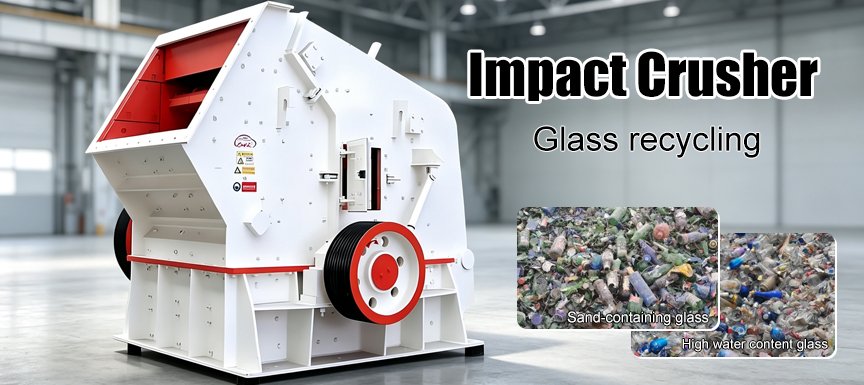
The impact crusher is a versatile tool in the glass recycling industry, particularly adept at handling materials with high moisture content and high hardness.
My Real Experience:
A customer who processes broken glass often encounters wet mud and sand mixed in with the broken glass, resulting in significant moisture loss. Hammer crushers frequently caused blockages, so they switched to a PF-1007 impact crusher. It features heating devices at the feed inlet and on the impact plates, effectively reducing material stickiness and significantly minimizing downtime due to blockages. Furthermore, its hammer replacements are exceptionally convenient, saving time and effort.
Advantages:
Resistant to moisture and hardness, this is its biggest advantage over hammer crushers. The output particle size can be flexibly controlled by adjusting the rotor speed or the impact plate gap. Since the material is primarily crushed by the front end of the hammers, the back and sides of the hammers experience minimal wear, resulting in high utilization.
Disadvantages:
High rotor balance is required. Improper calibration during installation can lead to significant vibration during operation, posing a safety hazard.
Applicable scenarios:
Processing broken glass containing wet soil, automotive or architectural glass with high hardness, and occasions requiring uniform particle size of output.
| Model Number | Specifications (mm) | Inlet Size (mm) | Maximum Feed Size (mm) | Processing Capacity (t/h) |
| PF-1007 | Φ1000×700 | 400×730 | 300 | 30-70 |
| PF-1010 | Φ1000×1050 | 400×1080 | 350 | 50-90 |
| PF-1210 | Φ1250×1050 | 400×1080 | 350 | 70-130 |
| PF-1214 | Φ1250×1400 | 400×1430 | 350 | 80-180 |
Compound Crusher: Silent Crushing
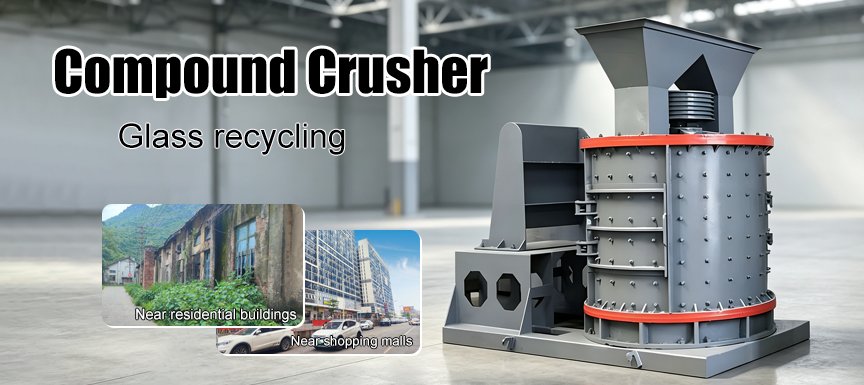
If you work at a recycling station near a residential area, or in a community or shopping mall with strict noise and dust control requirements, a compound crusher is the best choice.
My Real Experience:
I’ve seen this machine used in waste disposal stations in some upscale communities. Its biggest feature is its quiet operation. There’s almost no dust spillage. It uses a screenless design, specifically designed for high-moisture materials; it won’t clog at a moisture content of 8% or less.
Advantages:
Environmentally friendly and low noise. The screenless design completely solves the problem of wet material clogging. An internal elastic adjustment mechanism automatically discharges uncrushable hard objects. The output is cubic, with minimal iron contamination.
Disadvantages:
Due to its vertical structure, the material passes through quickly, and some materials may not be fully crushed. For scenarios requiring complete fine crushing into powder, the effect may not be as good as a hammer crusher.
Applicable scenarios:
Glass recycling in urban communities, shopping malls, and hotel kitchens with high environmental and noise control requirements.
| Model | Processing Capacity (t/h) | Motor Power (kw) |
| 800 | 5-15 | 4p 30kw |
| 1000 | 10-30 | 4p 55kw |
| 1250 | 20-60 | 6p 90kw |
Double Roll Crusher: The “Fine Grinder” of Glass Particles
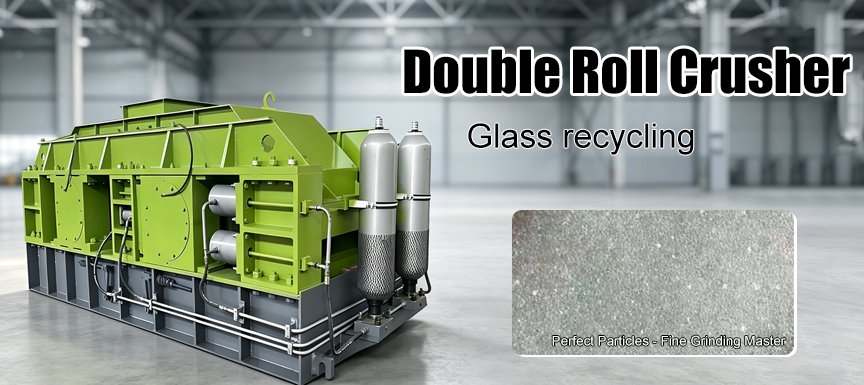
The double roll crusher is a typical example of compression crushing, especially suitable for medium to fine crushing of glass fragments, producing products with very uniform particle size.
My Real Experience:
Double roll crushers are ubiquitous on glass microsphere production lines where strict requirements are placed on the shape of glass particles. It uses two counter-rotating rollers to compress the glass. As long as the roller gap is properly adjusted, the resulting particles are uniform in size and regular in shape. It also handles wet, sticky materials well.
Advantages:
Uniform and controllable output particle size is its core advantage. Simple structure, small size, and easy installation and component replacement. Equipped with dustproof plates and protective covers, ensuring high operational safety.
Disadvantages:
Not well-suited for handling flaky materials; fragments can easily leak directly from the roller gap, affecting the crushing effect. The roller surface is also relatively prone to wear, potentially leading to uneven crushing force.
Applicable scenarios:
Raw material preparation for glass microsphere production; scenarios requiring uniform particle shape and size; secondary fine crushing of glass bottles.
| Model | 2PG0425 | 2PG0640 | 2PG0740 | 2PG0850 |
| Roller Diameter (mm) | Ф400 | Ф600 | Ф700 | Ф800 |
| Roller Width (mm) | 250 | 400 | 400 | 500 |
| Feed Size (mm) | ≤25 | ≤25 | ≤25 | ≤25 |
| Discharge Size (mm) | 2-8 | 2-8 | 2-8 | 2-8 |
| Processing Capacity (t/h) | 5-10 | 10-20 | 15-30 | 20-40 |
Conclusion
Ultimately, there’s no single “best” crusher, only the most suitable one. You need to consider a few questions first:
- What is your raw material? Is it clean, neatly arranged beer bottles, or a mixture of crushed glass containing sand, metal, and other debris? The hardness, moisture content, and impurity level of the raw material determine the types of machine that should be selected.
- How do you want it to be processed? Is it simply a matter of reducing volume for easier transport, or do you need to produce glass sand of a specific particle size for sale? This directly determines whether you need coarse, medium, or fine crushing equipment.
- What are your site conditions and budget? If space is limited, choose a compact compound crusher or hammer crusher; if your budget is ample and you are looking for long-term benefits, consider more durable and intelligent models.
If you are still unsure, please contact CHUNLEI engineers. We will recommend the most suitable equipment and production line solution for you based on your specific situation.
Latest News

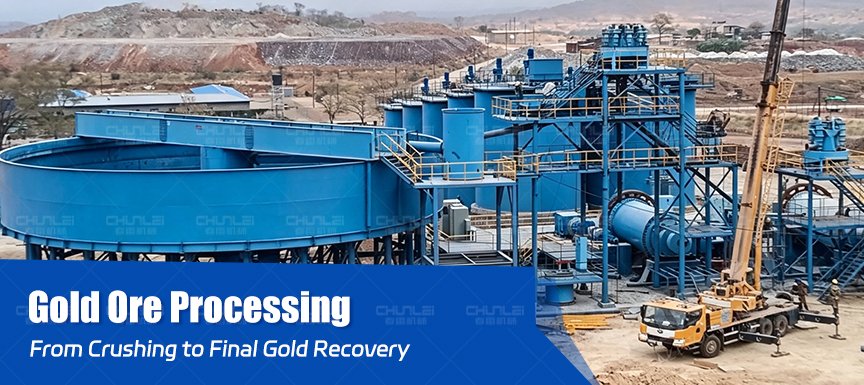
Gold Ore Processing: From Crushing to Final Gold Recovery
800A gold processing plant is not merely a simple assembly of crushers, ball mills, and gold recovery equipment; rather, the goal is to determine the optimal process flow based on factors such as mineral composition, gold particle size,…
-
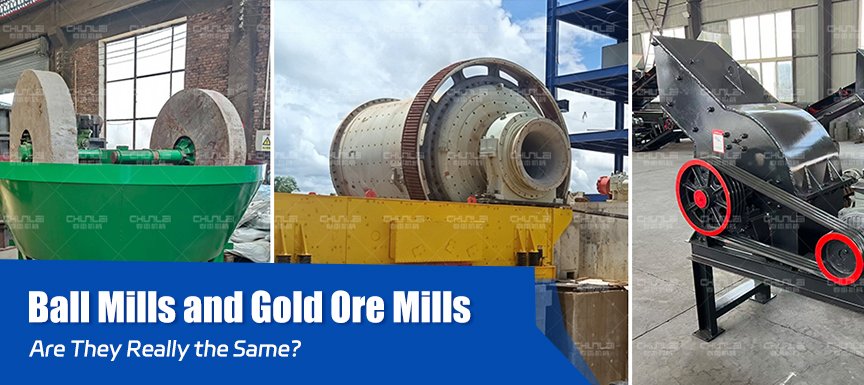
Ball Mills and Gold Ore Mills: Are They Really the Same?
800When searching for gold ore grinding equipment, customers often encounter various terms such as “Ball Mill,” “Gold Mill,” “Gold Milling Machine,” and “Gold Ore Grinding Machine.” Many buyers assume that a “Gold Mill” is a specialized mill de…
-
Mobile Crusher Buying Guide: Wheeled or Tracked?
800Many customers focus solely on portability when purchasing a mobile crusher, viewing it merely as the acquisition of a single piece of equipment. In reality, selecting the wrong model can lead to either insufficient output or excessive wear and…
-
Jaw Crushers and Impact Crushers: Turnkey Solutions for Concrete Recycling
800Demolishing old buildings and roads generates vast amounts of waste concrete; direct landfilling not only consumes valuable space but also incurs high transportation costs. The real challenge lies in transforming this waste concrete into reusab…
loading…
已经是到最后一篇内容了!