 Chunlei Mining Machinery


Raymond Mill
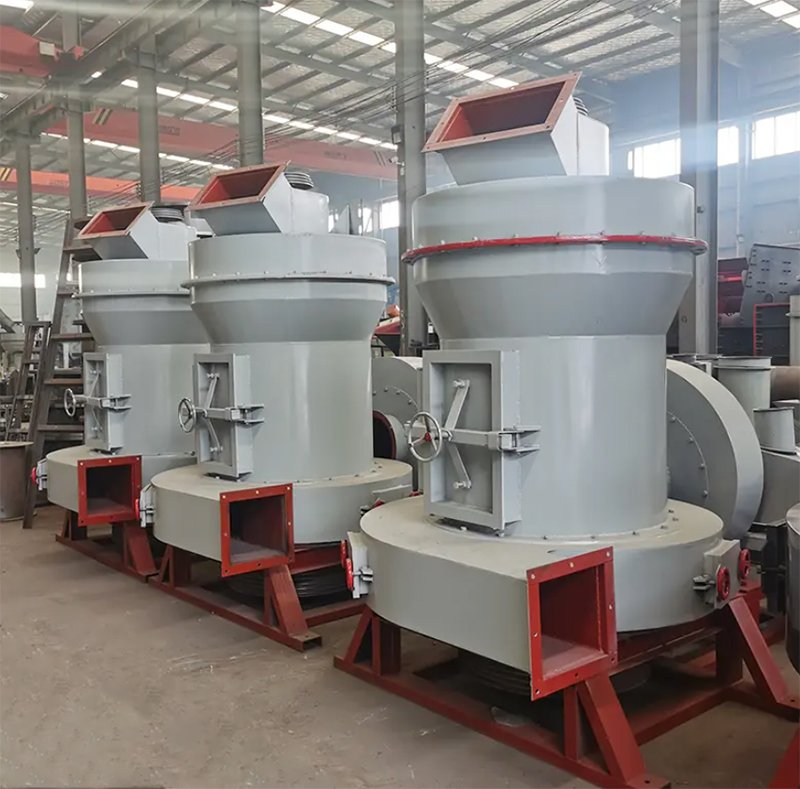
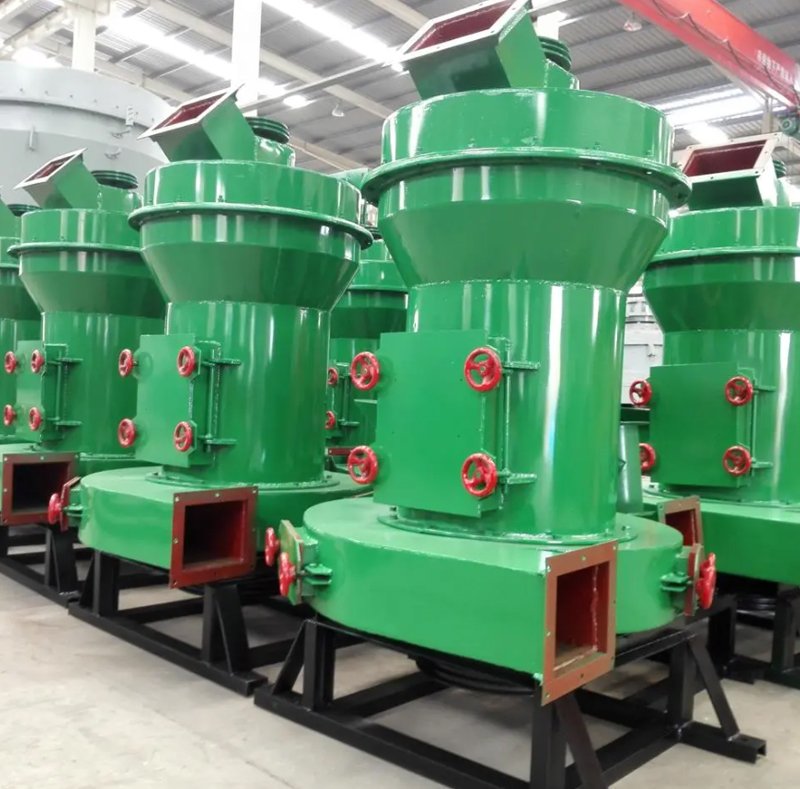
Raymond mill is a complete set of grinding equipment that can independently and autonomously generate a production system.
Applicable materials: limestone, calcite, quicklime, dolomite, barite, talc, calcium carbonate, gypsum, bentonite, kaolin, petroleum coke, coal and so on.
- Feed size:0-25mm
- Capacity:0.5–60 t/h
- Motor power :7.5-75KW
What is Raymond Mill?
The Raymond mill, also known as a suspended roller Raymond mill or ultrafine mill, is a vertical, dry, continuous grinding equipment. It relies on centrifugal grinding of grinding rollers and air classification to achieve dry ore grinding. The entire system operates under closed negative pressure and is widely used for grinding non-metallic minerals with a Mohs hardness ≤9.3 and low moisture content. The entire system consists of a main unit, classifier, blower, cyclone collector, pulse dust collector, elevator, and feeder. It forms an independent production line from lumpy raw materials to finished powder, eliminating the need for wet dewatering. It boasts high grinding efficiency and is a newer replacement for traditional mills and pendulum mills, widely used in power plant desulfurization, large-scale non-metallic mineral pulverization, and in building materials and chemical industries.
The Raymond mill’s unique air self-circulation system, combined with an advanced dust collector, fully embodies environmental protection principles. The grinding roller assembly is connected by tie rods and high-pressure springs, generating force to prevent large particles from causing wear and tear on the equipment. The flexible coupling between the main unit and the powder separator effectively reduces vibration and noise, extending the equipment’s service life.
Complete Four-Stage Standard Operating Procedure:
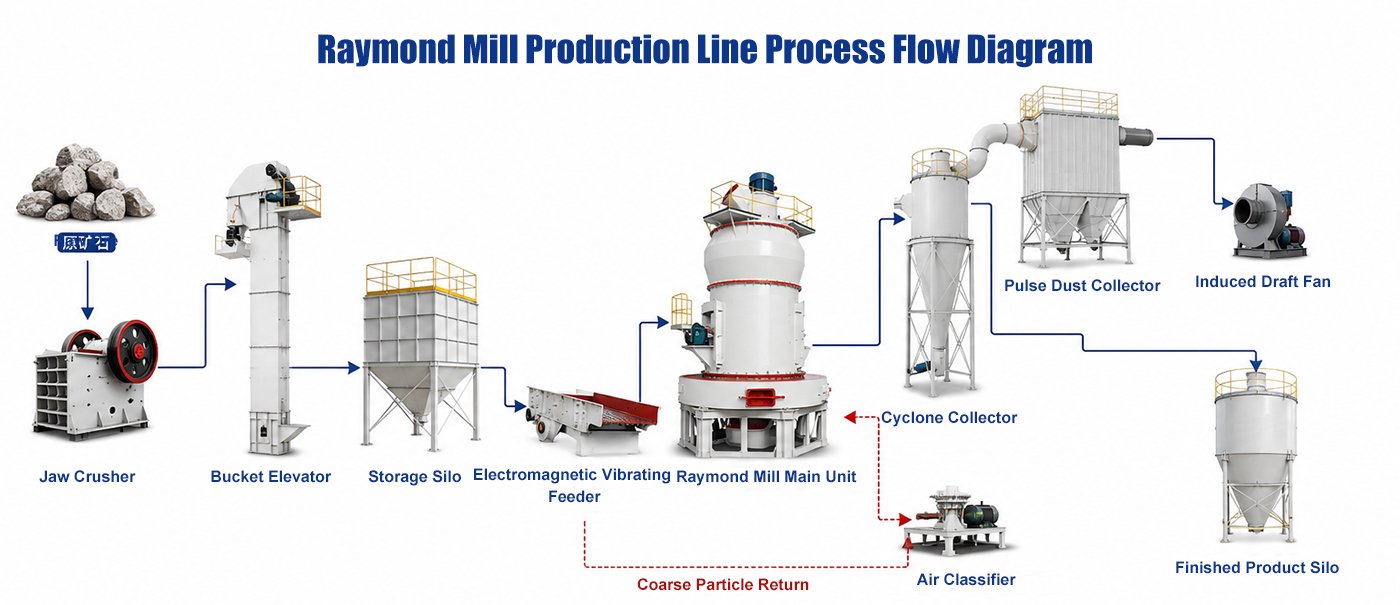
- Feeding and Conveying: Large stones are crushed by a jaw crusher and then conveyed to the storage silo by a bucket elevator;
- Grinding and Compressing: An electromagnetic feeder evenly feeds material into the grinding chamber. A centrifugal force compresses the grinding ring, and a shovel assists in turning and grinding the material;
- Airflow Classification: A fan circulates air to the top classifier. Coarse particles fall back for re-grinding, while qualified fine powder is collected by a cyclone separator;
- Dust Purification: Excess exhaust gas is filtered by a pulse dust collector, clean air is discharged, and the powder is collected at the bottom.
Working Principle of Raymond Mill
After crushed to the required size by the jaw crusher, the material is sent to the storage hopper of the Raymond mill by the elevator, and then the material is fed into the grinding chamber of the host machine by the electromagnetic vibrating feeder for grinding in a uniform and quantitative and continuous manner.
After grinding the material is fan airflow into the powder selector for classification, under the action of the impeller of the powder selector, the material that does not meet the requirements of fineness will fall into the grinding chamber to be regrinded, and the material that meets the requirements of fineness will enter the cyclone collector with the airflow through the pipeline to be separated and collected, and then discharged by the discharge device is the finished product powder.
The separated airflow enters into the fan through the return air pipe at the upper end of the cyclone powder collector.


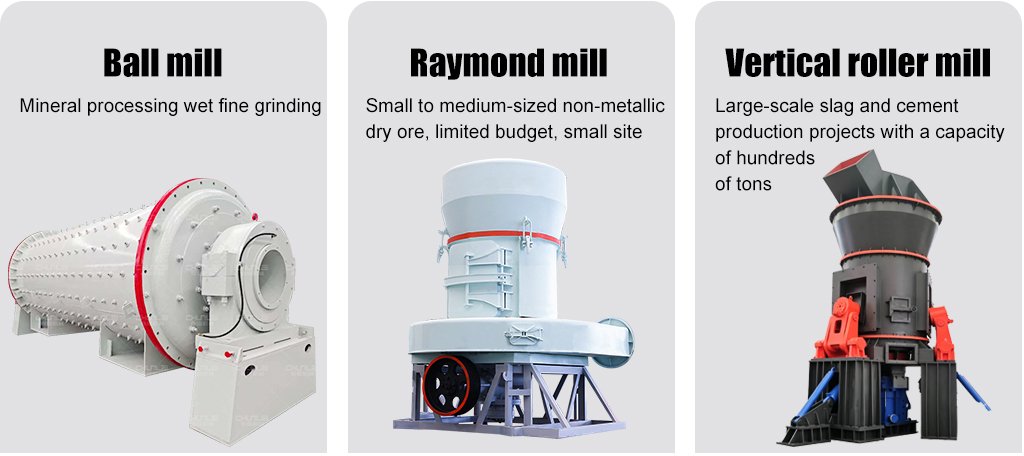
What are the differences between Raymond mills, ball mills, and vertical roller mills?
| Comparison Dimensions | Raymond Mill | Horizontal Ball Mill | Large Vertical Mill |
| Grinding Method | Dry airflow classification, intermittent feeding, continuous powder output | Dry and wet dual-use intermittent grinding | Drying + grinding integration |
| Applicable Material Hardness | Mohs ≤ 9.3, low moisture dry material | Unlimited hardness, suitable for both dry and wet slurries | High hardness, high moisture slag |
| Finished Product Fineness Range | 80–600 mesh | 200–1250 mesh | 30–3000 mesh ultrafine powder |
| Single Machine Capacity | 1–35t/h (Small to medium scale) | 5–100t/h | 20–250t/h (Large projects) |
| Landscaping Area | Vertical, compact, small footprint | Horizontal, long and narrow, large footprint | Large overall size, high civil engineering costs |
| Initial Purchase Investment | Low price, budget-friendly for small and medium-sized plants | Moderate to high cost | Expensive equipment |
| Energy Consumption Level | Moderate power consumption per unit powder | High power consumption | Power saving per unit capacity 20%+ |
| Material moisture content requirement | ≤6%, high moisture content requires pre-drying | No strict restrictions, wet grinding is acceptable | Allowed ≤15% Includes built-in drying duct |
| Typical industries | Calcium powder, gypsum, talc, kaolin filler | Mineral processing flotation fine grinding | Cement, slag powder large-scale plants |
Selection Summary
Raymond mills are preferred for small to medium-sized non-metallic dry ores with limited budgets and small spaces;
Ball mills are used for wet fine grinding in mineral processing;
Vertical roller mills are selected for large-scale projects such as slag and cement production with a capacity of hundreds of tons.
What ores are suitable for processing with Raymond mills?
Raymond mills are widely used grinding equipment for processing non-metallic mineral powders. They are suitable for processing over 300 kinds of minerals with a Mohs hardness of 7 or less and a moisture content of 6% or less, as well as non-flammable and non-explosive materials. With stable grinding performance, adjustable fineness, and low operating costs, Raymond mills are widely used in mining, building materials, chemical, metallurgical, and refractory materials industries.
Whether producing building materials, ceramic raw materials, chemical fillers, or environmentally friendly desulfurization powder and new energy mineral powders, Raymond mills can provide stable and efficient grinding solutions.
How to determine if an ore is suitable for a Raymond mill?
Generally, a Raymond mill can be used to process materials that meet the following conditions:
- Mohs hardness ≤ 7
- Material moisture content ≤ 6%
- Non-flammable and non-explosive material
- Requires a finished product fineness of 80–325 mesh
- Requires continuous, efficient, and energy-saving grinding.
For ores with high moisture content or high hardness, pretreatment equipment such as drying and crushing can be added according to actual working conditions to further improve production efficiency.
Different ores have different requirements for hardness, moisture content, feed particle size, and finished product fineness; therefore, grinding equipment also varies. Contact CHUNLEI engineers, we can provide customized grinding solutions based on your material type, output requirements, finished product fineness, and application industry to help you achieve high-output, low-energy-consumption products.
What equipment is needed to power a Raymond mill?
A complete Raymond mill production line requires not only the Raymond mill itself, but also crushing, conveying, feeding, grading, dust removal, and finished product collection equipment. A well-configured equipment system can not only increase output but also reduce energy consumption and costs.
| Supporting Equipment | Main Functions |
| Jaw Crusher | Crushes large pieces of ore to the allowable feed particle size of the Raymond mill. |
| Bucket Elevator | Continuously transports crushed material to the storage silo, improving conveying efficiency. |
| Storage Silo | Stores materials, ensuring continuous and stable feeding of the production line. |
| Electromagnetic Vibrating Feeder | Feeds material evenly and quantitatively to the Raymond mill, ensuring stable equipment operation. |
| Raymond Mill Main Unit | Grinds materials; the core equipment of the entire production line. |
| Analyzer (Powder Classifier) | Controls the fineness of the finished product; unqualified particles are returned for further grinding. |
| Blower | Provides airflow to transport powder and assists in powder classification. |
| Cyclone Collector | Collects qualified finished powder, improving powder recovery rate. |
| Pulse Jet Dust Collector | Collects dust, improving the production environment and meeting environmental protection requirements. |
| Electrical Control System (PLC, optional) | Enables centralized control of equipment, improving automation level. |
CHUNLEI can provide complete Raymond mill production line design and equipment configuration solutions based on material type, processing capacity, finished product fineness, and on-site conditions. Contact us for a free solution!
What are the easily worn parts of a Raymond mill?
During long-term operation, some parts of a Raymond mill will require regular inspection and replacement due to continuous wear. Timely maintenance of these easily worn parts not only ensures stable equipment operation but also improves grinding efficiency and extends the overall service life of the machine.
| Wear Parts | Main Function | 更换建Replacement Recommendations |
| Grinding Roller | Extrudes and grinds materials; a core grinding component. | Replace promptly or repair by welding when severely worn. |
| Grinding Ring | Works with the grinding roller to complete the grinding process; gradually wears off over time. | Inspect simultaneously with the grinding roller; replace both if necessary. |
| Shovel Blade | Scoops up material and feeds it between the grinding roller and grinding ring for grinding. | Wear will affect output; replace promptly. |
| Classifier Blades | Controls the fineness of the finished product, affecting powder classification. | Replace worn blades promptly to ensure stable finished product particle size. |
| Bearings | Supports equipment operation, ensuring smooth operation of the main unit. | Lubricate regularly; replace promptly if worn or showing abnormalities. |
| Seals | Prevents dust from entering bearings and transmission components. | Replace promptly if aged or damaged to prevent powder leakage. |
| Wear-resistant duct liners | Reduce wear on airflow channels and extend equipment life. | Inspect and replace regularly based on wear condition. |
How to extend the life of Raymond mill wear parts?
- Maintain uniform and continuous feeding to avoid overloading the equipment.
- Control the feed particle size to prevent large pieces of material from entering the grinding chamber.
- Regularly inspect the wear of the grinding rollers, grinding ring, and blades.
- Lubricate bearings and transmission components as required.
- Use high-quality original parts to ensure stable equipment operation.
Raymond Mill Common Faults and Solutions
- Coarser powder fineness and decreased output: Wear of grinding rollers/blades, excessively low classifier speed; replace wear-resistant parts, increase classifier speed;
- Clogged grinding chamber, no powder output: Excessive material moisture content, excessive feeding speed; pre-drying, reduce feeding frequency;
- Dust leakage, high dust levels in the workshop: Damaged filter bags, leaking air duct seals; replace dust collector filter bags, inspect pipeline flanges;
- Main unit vibration and abnormal noise: Loose anchor bolts, hard iron blocks entering the system; tighten the base, add an iron removal device at the front end;
- Insufficient fan airflow, low powder recovery: Dust accumulation and blockage in the air duct, periodically stop the machine to clean the pipeline.
Why Choose CHUNLEI Raymond Mills?
With years of experience and technology in mining equipment manufacturing, CHUNLEI has provided Raymond mills and complete grinding production line solutions to customers in many countries and regions worldwide.
- High Efficiency and Energy Saving: Optimized grinding roller, grinding ring, and air duct structure improve grinding efficiency and reduce unit energy consumption.
- Adjustable Finished Particle Size: Fineness can be flexibly adjusted between 80 and 325 mesh to meet the powder processing needs of different industries.
- Stable Output: Uniform feeding and a high-efficiency classification system ensure continuous and stable equipment operation.
- Long Wear-Resistant Life: Core wear parts are made of highly wear-resistant materials, reducing replacement frequency and maintenance costs.
- Environmentally Friendly and Low Dust: Equipped with a pulse dust removal system, dust emissions are low, meeting modern environmental protection production requirements.
- Intelligent Control: Optional PLC automatic control system enables centralized control, operation monitoring, and fault alarms, improving production efficiency.
- Customized configuration support: We provide customized equipment selection and production line design based on material hardness, moisture content, finished product fineness, and output requirements.
- One-stop service: From process design and equipment manufacturing to installation, commissioning, operation training, and after-sales service, we provide full-process technical support to help customers quickly start production.
If you also have this need, tell us your material characteristics and production requirements, and CHUNLEI engineers will provide you with a customized grinding solution, enabling you to achieve low energy consumption and high revenue. For a complete design solution and accurate quotation, contact CHUNLEI engineers immediately.


Technical Parameters of Raymond Mill
| Model | Number of grinding rollers(pcs) | Grinding roller dimensions | Grinding ring diameter and height | Feed size | Final product particle size(mm) | Main Motor Power(Kw) | Overall Dimensions(mm) | ||
| (mm) | (mm) | (mm) | 0.125 | 0.075 | 0.044 | ||||
| Capacity(t/h) | |||||||||
| 3R2115 | 3 | 210×150 | Φ630×150 | < 15 | 1.2-1.8 | 0.6-1.2 | 0.6-1.0 | 15 | 4500×2800×5800 |
| 3R2615 | 3 | 260×150 | Φ780×150 | 15-20 | 1.8-2.5 | 1.2-1.8 | 0.8-1.2 | 18.5 | 5650×3305×5950 |
| 3R2715 | 3 | 270×150 | Φ830×150 | 15-20 | 2.3-2.8 | 1.8-2.8 | 0.9-1.7 | 22 | 8000×3500×4900 |
| 3R3016 | 3 | 300×160 | Φ880×160 | 15-20 | 2.6-4 | 1.9-2.6 | 1.0-1.9 | 30 | 6500×4100×5200 |
| 4R3216 | 4 | 320×160 | Φ970×160 | 20-25 | 3.2-4.5 | 2.4-3.1 | 1.8-2.5 | 37 | 9900×5800×10580 |
Raymond Mill FAQ
Q: What could be causing my Raymond mill to produce very little or no powder?
A: This is usually caused by several factors: a faulty powder lock (discharge valve) causing air backflow, preventing powder from being discharged properly; or severely worn shovel blades preventing them from effectively scooping up material and feeding it between the grinding rollers and grinding ring; additionally, blocked air ducts or leaks at pipe connections can also reduce powder output.
Q: The finished powder’s fineness is either too coarse or too fine. What should I do?
A: Insufficient fineness is usually related to the classifier’s speed and airflow. If the powder is too coarse, the classifier blades may be severely worn and need replacement. You can also try slightly reducing the blower’s inlet valve. If the powder is too fine, you can increase the classifier’s speed or increase the blower’s airflow.
Q: My Raymond mill is vibrating excessively and making abnormal noise. What could be the problem?
A: There are several reasons for excessive vibration in the main unit: First, insufficient feed rate or worn scraper blades cause direct contact and impact between the grinding roller and grinding ring; second, severe wear or deformation of the grinding roller or grinding ring; third, loose anchor bolts or an unstable foundation; additionally, excessively hard material or the presence of metallic foreign objects can also lead to severe vibration.
Q: During operation, the main unit current and temperature rise, but the blower current decreases. What’s going on?
A: This phenomenon usually indicates that the feed rate is too fast, causing the air duct to be blocked by powder, resulting in poor exhaust and increased resistance to circulating airflow. This increases the load on the main unit and the current, while the blower current decreases due to reduced airflow. The solution is to immediately reduce the feed rate and clean the accumulated powder in the air duct.
Q: The Raymond mill blower vibrates very badly. How can this be handled?
A: Blower vibration is mainly caused by two reasons: First, excessive powder accumulation or severe wear on the blower blades leads to unbalanced operation; second, loose anchor bolts securing the blower. The solution is to clean the dust accumulated on the blades. If the wear is severe, the blades need to be replaced. At the same time, check and tighten the foundation bolts.
Q: The oil tank and transmission device of the equipment are abnormally hot. What could be the cause?
A: This is usually a lubrication problem or an incorrect rotation direction of the components. It could be that the oil viscosity is too high, preventing the oil pump from properly pumping oil to the upper bearing, causing friction and heat due to insufficient oil. It could also be that the analyzer’s rotation direction is not correct. Check the oil grade and verify the analyzer’s rotation direction.
Q: The bearings of the grinding roller assembly are easily damaged. What causes this?
A: Bearing damage is usually related to lubrication and sealing. The main causes are insufficient oil (oil starvation) or damaged seals, allowing dust to enter the bearing and accelerate wear. In addition, a long-term lack of necessary maintenance and cleaning is also a significant cause. The solution is to add oil at the specified time and regularly clean and replace the oil seals.
Q: Why do the grinding rollers and grinding rings wear so quickly, and how can their lifespan be extended?
A: Rapid wear is usually caused by several factors: excessively large feed particle size, increasing grinding difficulty; excessively high grinding pressure; or the material hardness exceeding the equipment’s tolerance (above Mohs hardness 7). In addition, excessively high material moisture content (above 6%) will also accelerate wear. Strict control of feed particle size and material hardness is necessary, and worn parts should be inspected and replaced regularly.
Q: Are there any specific requirements for the materials processed by a Raymond mill?
A: Yes. Raymond mills are mainly suitable for processing non-flammable and non-explosive mineral materials with a Mohs hardness of no more than 7 and a moisture content of less than 6%. Common examples include limestone, calcite, barite, and gypsum. If the material hardness is too high or the moisture content is too high, it will not only reduce output but also exacerbate equipment wear.
Q: What precautions should be taken before putting a newly installed Raymond mill into production?
A: After the new machine is installed, a no-load test run must be performed before formal production. The main unit must run idle for at least 1 hour, and the blower should be started normally under no-load before loading. During the no-load test run, the grinding roller assembly needs to be securely fastened with steel wire ropes to prevent impact between the grinding rollers and the grinding ring. After the test run is successful, start the machine for production in the correct sequence (elevator → crusher → classifier → blower → main unit → feeder).
Related Products —
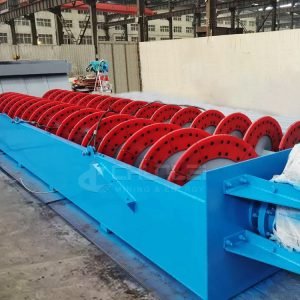
Spiral Sand Washing Machine
Spiral Sand Washing Machine, also known as gravel washing machine or Spiral sand washer, can be divided into single screw sand washing machine and double screw sand washing machine due to the different number of screws inside the screw s…
Ceramic Filter Press
Ceramic Filter Press is a kind of high-efficiency and energy-saving filtration equipment relying on vacuum suction and capillary action to realize solid-liquid separation, which is widely used in mining, metallurgy, chemical industry, en…
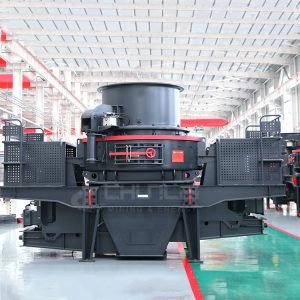
Sand Making Machine
The impact sand making machine (vertical shaft impact crusher) is a core piece of equipment in the fields of sand and gravel aggregate processing and ore shaping, and is particularly suitable for the sand-making and sha…
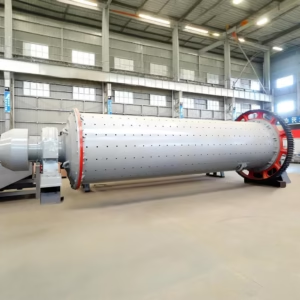
Ceramic Ball Mill
The ceramic ball mill is a core piece of equipment designed for grinding high-purity non-metallic minerals and chemical raw materials. Featuring linings and grinding media made of alumina or zirconia ceramics, it is …
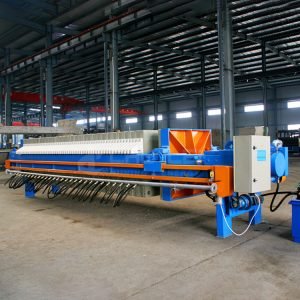
Hydraulic Filter Press
A variety of models are available | Get the free price list! Hydraulic filter press, also called automatic hydraulic filter press, is a dewatering equipment that utilizes slurry pump pressure to make the liquid com…

loading…
已经是到最后一篇内容了!