 Chunlei Mining Machinery
Best Barite Grinding Mill Recommendations: How to Choose the Right Equipment for Your Project?
Barite is a non-metallic mineral widely used in industries such as oil and gas drilling, coatings, plastics, rubber, chemicals, and pharmaceuticals. Different industries have different requirements for powder fineness; therefore, it is crucial to match the chosen barite grinding mill to your specific needs. A suitable barite grinding mill directly impacts product quality, production efficiency, and cost.
Many customers prioritize price when purchasing equipment, but no single grinding mill is suitable for every project. Which barite grinding mill is best? The right grinding mill for your needs depends on the desired fineness of the finished product, processing capacity, material characteristics, and your investment budget.
This article compares four of the most common barite grinding mills currently on the market to help you quickly find the solution best suited to your project.
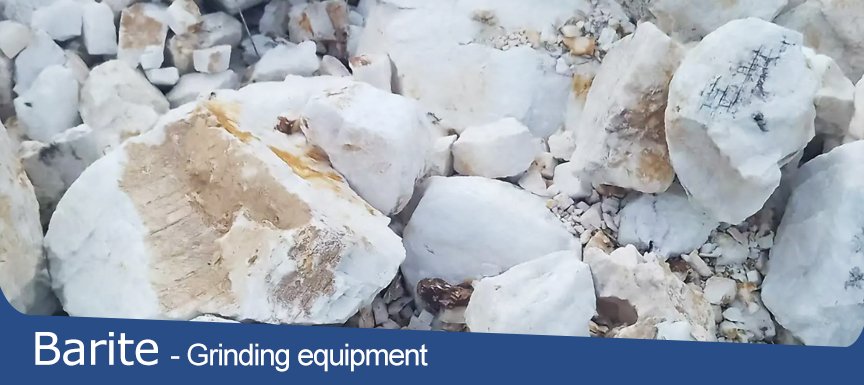
What are the uses of barite?
Barite has a wide range of applications, and different industries have different requirements for its fineness and quality. The table below shows the main application areas of barite and common fineness requirements to help you quickly understand the processing needs of different markets.
| Application Industries | Main Uses | Common Fineness Requirements |
| Oil & Gas Drilling | Formulating drilling mud, increasing mud density, stabilizing the wellbore, and preventing blowouts | API standard, 200–325 mesh |
| Chemical Industry | Used as a filler, weighting agent, and chemical raw material to improve product stability | 325–1250mesh |
| Coatings Industry | Improving coating hiding power, weather resistance, and gloss; improving leveling properties | 600–3000mesh |
| Plastics Industry | As a functional filler to improve hardness, dimensional stability, and abrasion resistance | 800–2500mesh |
| Rubber Industry | Increasing product weight, improving abrasion resistance and aging resistance Chemical properties improved, production costs reduced. | 325–1250mesh |
| Paper Industry | Improves paper whiteness, smoothness, and printability | 800–2000mesh |
| Pharmaceutical Industry | Used in medical imaging contrast agents and as a raw material for some pharmaceutical products (requires high-purity barite) | Ultra-fine, high-purity |
| Building Materials | Used in cement, mortar, radiation-shielding concrete, and special building materials | 200–600mesh |
| Glass Industry | As a glass additive, improving transparency and chemical stability | 325–1250mesh |
| Nuclear Power and Radiation Protection Engineering | Manufacturing radiation-shielding concrete, hospital CT rooms, and nuclear power plant protective walls | Customized according to project requirements |
Why is choosing the right barite grinding mill so important?
Different barite processing companies have different production goals.
For example, the drilling mud industry typically needs to stably produce 200-325 mesh barite powder; while the coatings, plastics, and rubber industries focus more on ultrafine powders of 800 mesh or higher.
If the equipment selection is inappropriate, the following may occur:
- Insufficient finished product fineness
- Excessive energy consumption and increased operating costs
- Insufficient equipment output
- High maintenance costs
- Decreased product competitiveness
Therefore, when selecting grinding equipment, it is recommended to focus on the following aspects:
- Finished product particle size requirements
- Hourly processing capacity
- Dry or wet processing
- Project investment budget
- Future expansion needs
- Maintenance costs
Compared to simply pursuing the lowest price, choosing equipment truly suitable for your operating conditions often yields a higher return on investment.
Comparison of Four Common Barite Grinding Mills
Common barite powder grinding mills include ball mills, Raymond mills, ultrafine mills, and vertical roller mills. Learn more about CHUNLEI barite grinding mills, including their advantages, wear parts, and maintenance.
1. Barite Ball Mill
The biggest difference between a ball mill and a Raymond mill is that it is more commonly used in wet grinding and mineral processing production lines. It is usually combined with a hydrocyclone to form a closed-circuit grinding system, which can meet the long-term continuous production needs of medium and large-scale mineral processing plants. It is widely used in the processing of barite, gold, copper, iron, and other minerals.
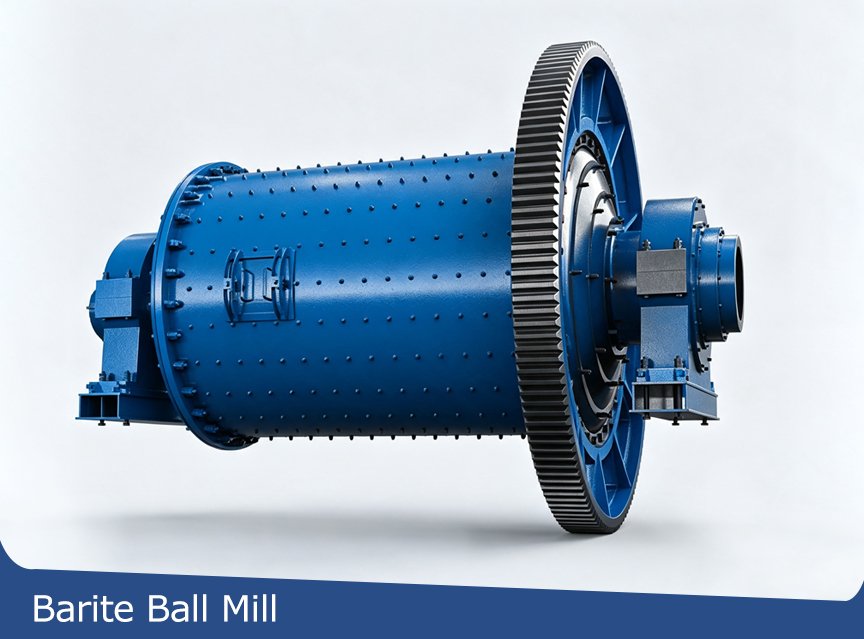
Advantages of Ball Mills:
- Maximum grinding output can reach 615 tons per hour.
- Processes raw ores with high hardness and large particle size.
- Ball mills are more adaptable to materials and can stably process barite of different grades and hardnesses.
- Combined with a hydrocyclone to form a closed-circuit grinding system, it achieves a more uniform product particle size.
- Strong continuous operation capability and stable operation.
Ball Mill Wear Parts:
During long-term operation of the ball mill, the following parts are considered normal wear parts and require regular inspection and replacement:
- Ball mill liners: Subjected to constant impact and wear from steel balls and ore, they are among the most frequently replaced parts.
- Steel balls (grinding media): Wear occurs continuously during the grinding process and requires regular replenishment and replacement.
- Bridging plates: Constantly subjected to material erosion, wear will affect grinding efficiency and material flow.
- Hollow shaft bushings: In constant contact with slurry, wear may affect equipment sealing and operational stability.
- Bearings and seals: Prone to aging or wear after long-term operation and should be lubricated, inspected, and replaced regularly.
Ball Mill Maintenance and Care Recommendations:
Regularly check the wear of vulnerable parts such as liners, steel balls, and bearings, and replenish or replace them promptly; maintain good bearing lubrication, and check the operating status of gears, motors, and transmission systems; after shutdown, clean up accumulated material promptly and check whether bolts and seals are loose or aged. This can effectively reduce the failure rate and extend the service life of the equipment.
2. Raymond Mill for Barite
The Raymond mill is one of the most widely used barite grinding equipment, especially suitable for processing medium to low fineness powders.
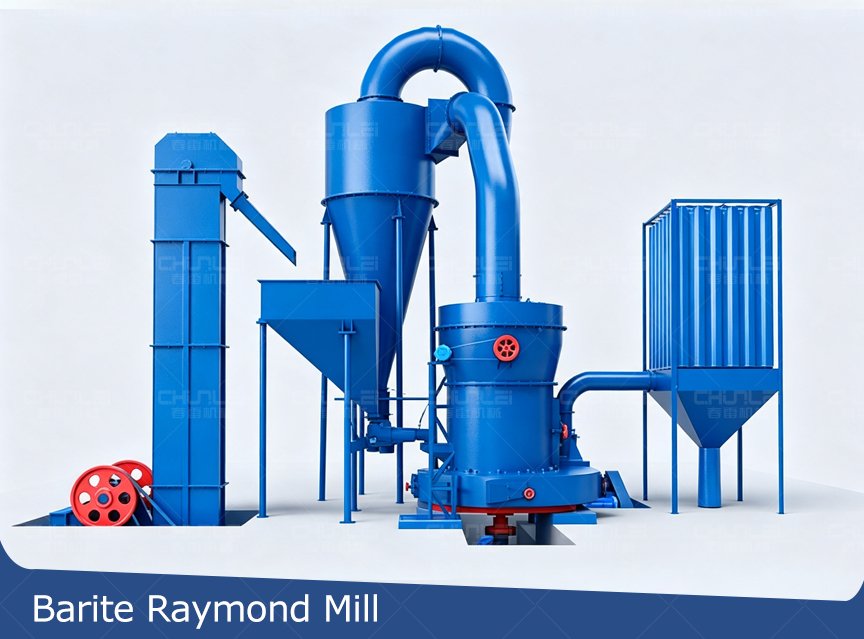
Advantages of the Raymond Mill:
- Grinding fineness range from 80 mesh to 325 mesh.
- Low energy consumption, stable output, and can quickly process barite into powder of the required fineness.
- Low operating cost and small footprint.
- Utilizes negative pressure operation and a high-efficiency dust removal system to reduce dust pollution and create a cleaner working environment.
- Not only suitable for barite, but also for processing various non-metallic minerals such as calcite, limestone, and talc.
Wear Components of the Raymond Mill:
- Grinding Roller: The main grinding component, subjected to long-term material impact and extrusion pressure, is prone to wear. Made of high-strength wear-resistant alloy material to improve durability and lifespan.
- Grinding Ring: The grinding ring works simultaneously with the grinding roller and is subjected to continuous friction, therefore requiring good wear resistance. Made of high-quality wear-resistant steel, ensuring long-term stable operation of the equipment.
- Shovel Blade (Blade): Primarily responsible for scooping up materials and feeding them into the grinding area, it gradually wears down through continuous contact with the materials. Due to its high workload, the shovel blade generally requires regular inspection and replacement to ensure grinding efficiency.
3. Barite Ultrafine Grinding Mill
The ultrafine mill is mainly used to produce high-value-added barite ultrafine powder, meeting the high fineness requirements of large-scale production plants. It is widely used in industries such as coatings, plastics, rubber, and pharmaceuticals.
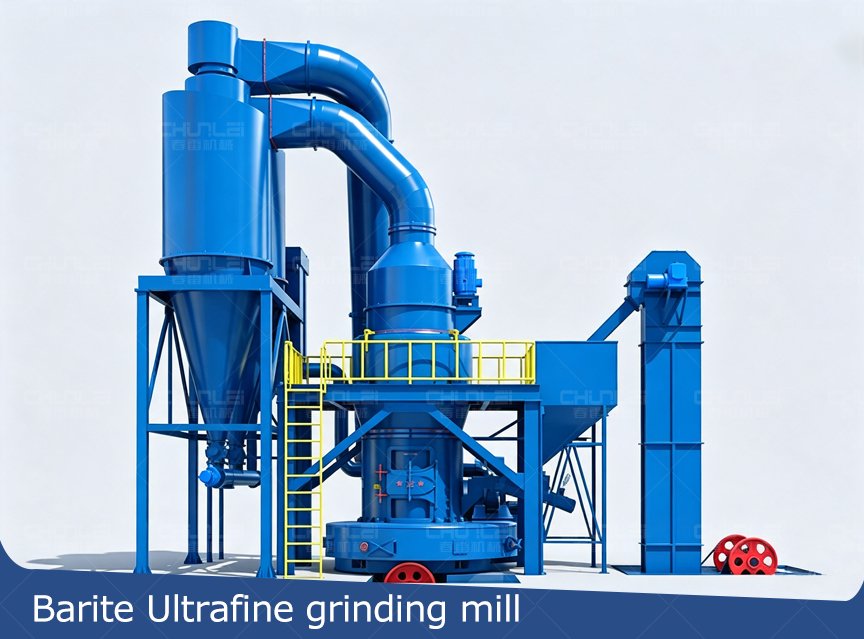
Advantages of the Ultrafine Grinding Mill:
- Highest grinding fineness, adjustable fineness.
- Equipped with a high-efficiency classification system to control powder particle size, resulting in higher finished product quality.
- Low energy consumption during equipment operation; adopts a closed dust collection design to reduce dust pollution.
- In addition to barite, it is also suitable for processing non-metallic minerals such as calcite, limestone, and talc.
Vulnerable Parts of the Ultrafine Grinding Mill:
- Grinding rollers and grinding rings: Directly in contact with materials, they are subjected to stress and friction over long periods, leading to severe damage. They are usually made of wear-resistant materials such as high-manganese steel or special alloy steel.
- Classifying impellers: Subjected to powder impact during high-speed operation, they may wear, affecting the fineness of the finished product. Regularly check the impeller condition, adjust operating parameters, and replace if necessary.
- Seals and bearings: Temperature rise or noise problems may occur during long-term operation. Perform proper lubrication and sealing maintenance, and regularly check the operating condition of the bearings.
4. Barite Vertical Grinding Mill
In recent years, vertical grinding mills have become increasingly popular in large-scale powder processing projects due to their energy-saving and high-yield advantages. They integrate grinding, grading, and drying, effectively reducing system energy consumption.
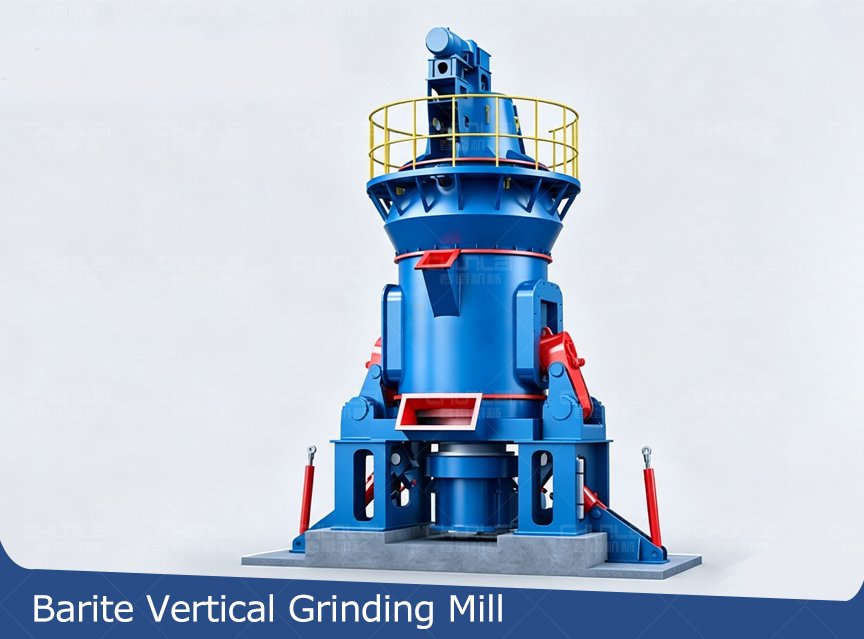
Advantages of Vertical Grinding Mills:
- The vertical structure design ensures more thorough grinding and higher efficiency, making them suitable for large-scale continuous production of barite.
- The grading system precisely controls powder fineness, meeting the particle size requirements of barite powder in various fields.
- Compared to traditional grinding equipment, vertical grinding mills use a bed grinding method, resulting in lower energy consumption and more economical operation.
- In conjunction with a dust removal system, dust emissions are effectively reduced, improving the production environment.
Vulnerable parts of vertical grinding mill and their solutions:
| Wear Parts | Causes of Wear | Solutions |
| Grinding Rollers | Prolonged contact with barite materials causes surface wear due to compression and friction. | Select high-wear-resistant alloy materials, regularly check roller wear, and repair or replace as needed. |
| Grinding Disc Liners | Bear material impact and continuous grinding, they are one of the main load-bearing components. | Use wear-resistant liners and properly control feed particle size to reduce abnormal wear. |
| Grading Blades | Constantly collide with powder particles during high-speed rotation, leading to wear. | Clean and inspect blades regularly, and replace them promptly according to their wear. |
| Seals | Aging or damage is common after prolonged operation, leading to air leaks and reduced equipment efficiency. | Perform daily maintenance and replace components promptly if seal performance deteriorates. |
| Hydraulic system components | Pressure instability or component wear may occur during prolonged operation. | Regularly check hydraulic oil quality and system pressure, and perform timely maintenance. |
Which barite grinding mill is best for your project?
We understand that every grinding project is unique, and there is no “best” equipment, only the “most suitable” equipment. CHUNLEI is committed to providing tailored barite grinding solutions to meet the needs of your industry. Our engineers will recommend the most suitable barite grinding mill based on your requirements. Below is a comparison of four barite grinding mills:
| Equipment Type | Recommended Fineness | Processing Capacity | Main Features | Applicable Scenarios |
| Ball Mill | Approximately 200-325 mesh | Medium to Large | High grinding intensity, stable operation, suitable for continuous production | Suitable for barite coarse processing, industrial fillers, mineral processing, etc. |
| Raymond Mill | 80-400 mesh | Medium | Low investment cost, simple structure, easy maintenance | Suitable for medium to fine powder processing, such as drilling mud, chemical, and building materials industries |
| Vertical Mill | 80-600 mesh | Large | High output, low energy consumption, small footprint | Suitable for large-scale barite powder production lines |
| Ultrafine Mill | 325-2500 mesh and above | Medium to Small | High powder fineness, uniform particle size, suitable for fine processing | Suitable for high-value-added barite powder, such as coatings, pharmaceuticals, fine chemicals, etc. |
Customer Case Study (Barite Grinding Plant)
Barite Ball Mill Production Line in Turkey
A barite processing plant in Turkey primarily produces industrial-grade barite powder, used in drilling, chemical, and other fields. The project utilizes a Φ2700×4500 ball mill for barite grinding. This equipment uses the impact and grinding action of steel balls to achieve the required fineness of the barite, meeting the customer’s production needs.
| Project | Parameters |
| Project Location | Turkey |
| Processed Material | Barite |
| Core Equipment | Φ2700×4500 Ball Mill |
| Recommended Fineness | Approx. 100 mesh |
| Processing Capacity | Approx. 80 t/h |
| Production Characteristics | Continuous operation, stable grinding, suitable for large-scale production |
| Customer Feedback | The equipment operates stably, and the fineness and purity of the finished product meet production requirements. Customers expressed approval of the initial design and technical support. |
Mexican Barite Grinding Plant
This Mexican barite powder processing company primarily produces drilling-grade barite powder. Based on customer requirements for output and finished product fineness, the project utilizes the MTM160 Raymond mill as the core grinding equipment to achieve continuous and stable barite processing.
| Project | Parameters |
| Processed Material | Barite |
| Project Location | Mexico |
| Equipment Used | MTM160 Raymond Mill |
| Recommended Fineness | 200mesh |
| Design Output | 12-12-14 tons/hour |
| Application Area | Oil Drilling Mud Weighting Agent |
| Customer Feedback | The equipment operates stably, the finished product fineness meets production requirements, and the customer is satisfied with the equipment performance and service. |
Conclusion
When choosing a barite grinding mill, the key is not to buy the most expensive equipment, but to choose the solution that best meets your own production needs.
If you produce ordinary barite powder, Raymond mill is usually a more economical choice; wet grinding projects are more suitable for ball mills; large-scale continuous production can give priority to vertical mills; and for high value-added ultra-fine powder processing, it is recommended to use ultra-fine mills.
As an experienced barite grinding machine manufacturer, CHUNLEI Machinery is always ready to contribute the most professional and sincere efforts to your barite grinding project.
Latest News

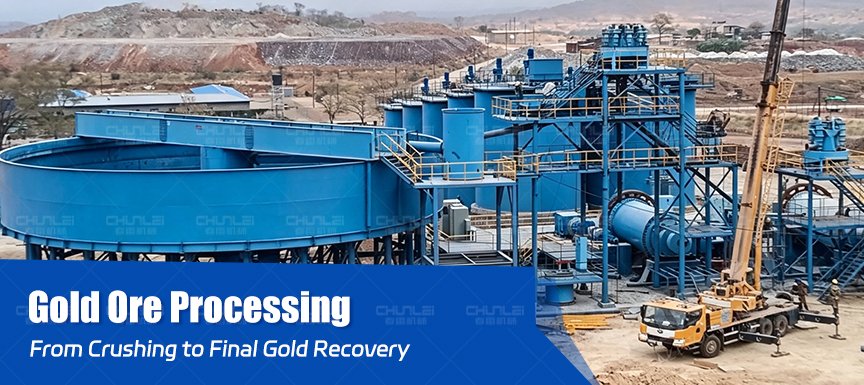
Gold Ore Processing: From Crushing to Final Gold Recovery
800A gold processing plant is not merely a simple assembly of crushers, ball mills, and gold recovery equipment; rather, the goal is to determine the optimal process flow based on factors such as mineral composition, gold particle size,…
-
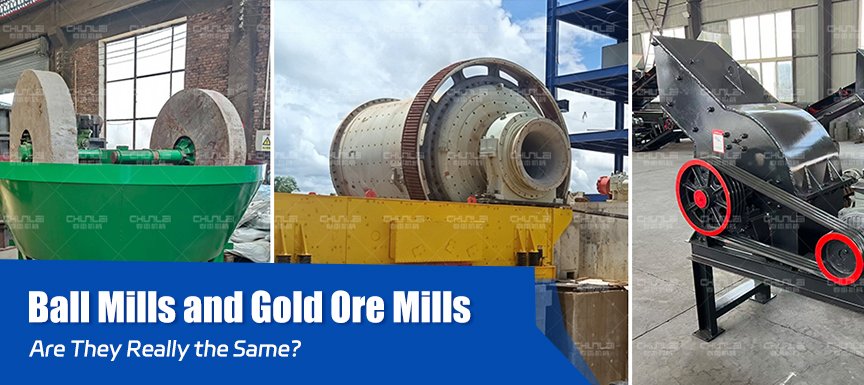
Ball Mills and Gold Ore Mills: Are They Really the Same?
800When searching for gold ore grinding equipment, customers often encounter various terms such as “Ball Mill,” “Gold Mill,” “Gold Milling Machine,” and “Gold Ore Grinding Machine.” Many buyers assume that a “Gold Mill” is a specialized mill de…
-
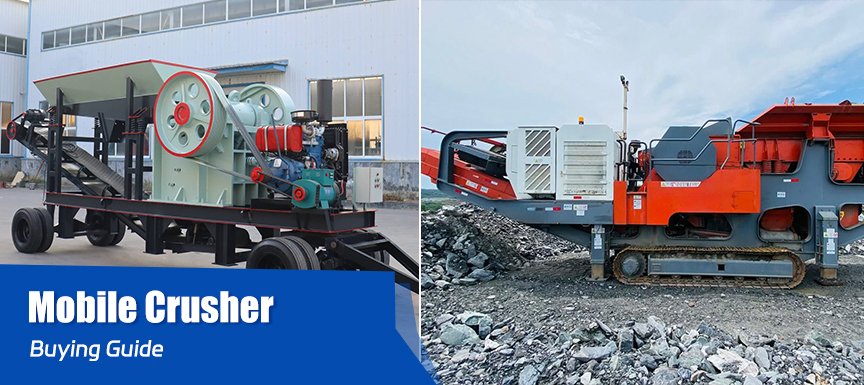
Mobile Crusher Buying Guide: Wheeled or Tracked?
800Many customers focus solely on portability when purchasing a mobile crusher, viewing it merely as the acquisition of a single piece of equipment. In reality, selecting the wrong model can lead to either insufficient output or excessive wear and…
-
Jaw Crushers and Impact Crushers: Turnkey Solutions for Concrete Recycling
800Demolishing old buildings and roads generates vast amounts of waste concrete; direct landfilling not only consumes valuable space but also incurs high transportation costs. The real challenge lies in transforming this waste concrete into reusab…
loading…
已经是到最后一篇内容了!