 Chunlei Mining Machinery
Closed-Circuit Grinding Process: Ball Mill and Hydrocyclone
In the design of modern mineral processing plants, an efficient and well-structured grinding and classification circuit involves far more than simply selecting a specific size of ball mill or connecting a ball mill to a hydrocyclone with piping. The core challenge lies in resolving mismatches between the capacities and operating parameters of the ball mill and the hydrocyclone. This article provides an in-depth analysis of the operational logic behind the ball mill-hydrocyclone closed-circuit system, key design steps, and common pitfalls encountered during on-site commissioning.
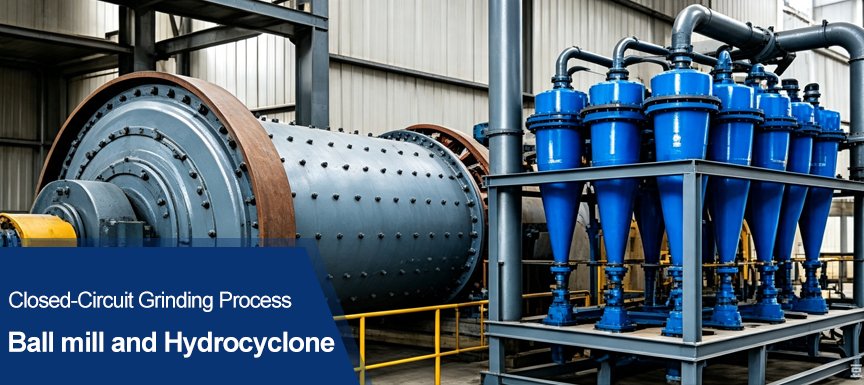
Why configure the ball mill and hydrocyclone in a closed circuit?
In a grinding and classification circuit, the ball mill is responsible for the progressive liberation of valuable minerals from gangue, while the hydrocyclone handles particle size classification. Simply put: the ball mill handles the “grinding,” and the hydrocyclone handles the “separation.”
After the slurry is discharged from the ball mill, a slurry pump lifts it into the hydrocyclone, establishing the following cycle:
- Overflow (fine fraction): Fine particles that meet the target liberation size exit through the hydrocyclone’s overflow pipe and proceed to the next stage of beneficiation (e.g., flotation, magnetic separation, or gravity separation);
- Underflow/Sands (coarse fraction): Coarser particles that do not meet size specifications exit through the hydrocyclone’s underflow port and are returned to the ball mill feed inlet for regrinding;
- Closed-circuit loop: Coarse particles are continuously returned for regrinding until they reach the required particle size.

The goal of optimizing grinding circuit design is not merely to assemble equipment; rather, it is to utilize efficient classification to ensure that fine particles meeting specifications are promptly discharged from the system—thereby preventing over-grinding and reducing energy consumption and equipment wear across the entire production line.
Typical Ball Mill and Hydrocyclone Process Flow
A standard, typical closed-circuit grinding process flow involving a ball mill and a hydrocyclone is outlined below:
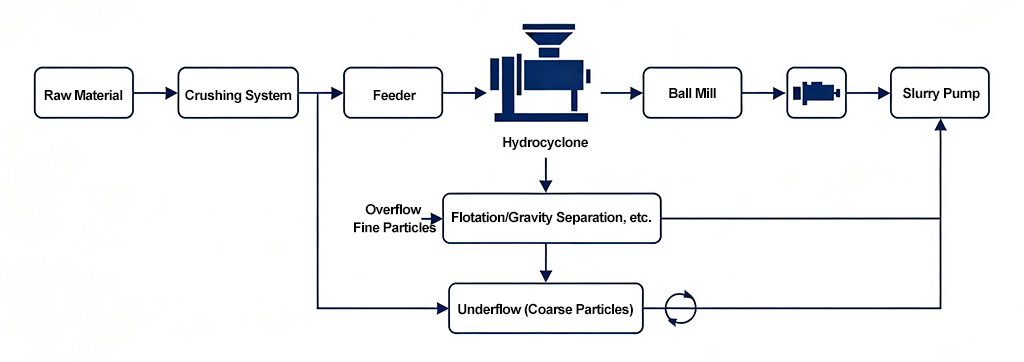
In actual industrial production lines, this process can be expanded or modified based on ore characteristics and beneficiation requirements to include:
- Pre-screening/Check screening: Vibrating screens or linear screens (to control feed particle size);
- Magnetic separation equipment: For pre-concentration (rejecting barren gangue) or magnetic recovery;
- Thickening equipment: High-efficiency thickeners (to adjust slurry concentration for the next stage);
- Secondary grinding: Regrind ball mills or vertical mills;
- Parallel hydrocyclone arrays: Hydrocyclone clusters (to handle high throughput).
For instance, high-efficiency hydrocyclones from premium brands like CHUNLEI are widely used in closed-circuit ball mill grinding, fine particle classification, and desliming operations; by optimizing internal flow fields and centrifugal force dynamics, they significantly enhance classification efficiency and reduce the over-grinding of recirculating loads.
Seven Key Steps in Process Flow Design
1. Determine the final product particle size first
Avoid the mistake of “selecting the ball mill model first and then trying to achieve the desired grinding fineness.” The correct logical sequence is:
Analysis of ore properties → Mineral liberation requirements → Determination of target product size → Selection of grinding equipment → Matching with classification equipment.
Example: Flotation processes typically require 60%–90% of the material to be finer than 200 mesh, necessitating strict avoidance of over-grinding and pulverization; conversely, gravity separation processes require the timely recovery of liberated coarse particles to prevent the valuable minerals from turning into slime.
2. Determine ball mill capacity and specifications
Calculating the ball mill’s processing capacity (t/h) requires comprehensive consideration of:
- Required raw ore throughput;
- Ore hardness and Bond Work Index (WI);
- Feed particle size (mill inlet size) and target discharge particle size;
- Mill filling rate and liner configuration.
Note: Feed particle size is critical! If the upstream crushing system is unstable and the feed size is too large, simply increasing the ball mill’s specifications will not boost productivity but will instead significantly increase power consumption.
3. Determine hydrocyclone classification parameters
When selecting a hydrocyclone, one cannot simply look at “tonnage processed per hour”; a comprehensive evaluation is required regarding:
- Throughput and feed pressure range;
- Feed particle size distribution and slurry volumetric concentration;
- Target cut size ($d_{50}$);
- Cyclone structural parameters: diameter, feed inlet dimensions, overflow pipe diameter, and apex (underflow) orifice size.
4. Accurately calculate the circulating load
In closed-circuit grinding design, the circulating load (CL) is a key metric determining the selection of the ball mill and pump box. The formula for calculating the circulating load ratio is:
CL = (C / F) × 100%, where:
- CL = Circulating load;
- C = Underflow rate returned to the ball mill;
- F = Fresh feed rate. Parameter Definitions:
For example, purely for calculation purposes:
If the fresh feed rate is 100 t/h and the cyclone underflow return rate is 200 t/h:
CL = (200 / 100) × 100% = 200%. This does not mean that the entire 200 t/h consists of fresh ore; rather, it indicates that a significant portion of the slurry actually processed by the ball mill originates from the circulating material returned by the cyclone.
Note: The figures in this example are used solely to illustrate the calculation method and do not represent design values for any specific mine.
5. Strictly control slurry concentration
Hydrocyclones operate based on the principle of centrifugal sedimentation and are extremely sensitive to slurry concentration. Significant fluctuations in slurry concentration can lead to:
- Coarsening or excessive fineness of the overflow particle size, affecting downstream beneficiation;
- “Roping” discharge in the underflow, resulting in a loss of classification efficiency;
- “Overloading” (choking) or “empty running” of the ball mill.
6. Design a stable feed pressure and pumping system
Hydrocyclones have no moving parts; the centrifugal force relies entirely on the feed pressure provided by the slurry pump. Therefore, the ball mill $\to$ pump box $\to$ slurry pump $\to$ hydrocyclone sequence constitutes an integrated dynamic system. It is essential to ensure a stable pump box level and variable-frequency pump control to prevent pressure fluctuations.
7. On-site data integration and closed-loop optimization
After the system is commissioned, a multi-parameter coordinated monitoring mechanism must be established, focusing on:
Ball mill current + pump feed pressure + slurry concentration + cyclone overflow fineness + underflow condition
Only when these parameters maintain a long-term dynamic balance can the grinding and classification circuit be considered to have achieved optimal matching.
What parameters affect grinding and classification performance?
In a closed-circuit system comprising a ball mill and a hydrocyclone, performance is not determined by a single parameter; rather, attention must be paid to several factors simultaneously:
- Feed particle size: Excessively coarse feed increases the ball mill’s load and can adversely affect the final grinding fineness.
- Ore hardness and grindability: Harder-to-grind ores typically require more grinding energy; identical equipment settings may yield different results depending on the ore type.
- Feed rate: Fluctuations in the feed rate directly impact the ball mill load and the operating status of the hydrocyclone.
- Slurry concentration: Changes in concentration affect both the grinding efficiency of the ball mill and the classification performance of the hydrocyclone.
- Ball mill grinding media gradation: Improper sizing or proportions of steel balls can lead to coarse particles remaining unground or fine particles being over-ground.
- Ball filling rate: This influences the impact and attrition actions occurring inside the ball mill.
- Hydrocyclone feed pressure: Unstable pressure often leads to fluctuations in overflow particle size.
- Hydrocyclone model and specifications: Parameters such as cyclone diameter, apex (underflow) nozzle size, and vortex finder (overflow pipe) dimensions affect classification results.
- Circulating load: Variations in the amount of underflow returned to the mill alter the actual processing load on the ball mill.
- Target product particle size: The required final fineness directly dictates the design of the entire grinding and classification circuit.
- Equipment wear: Wear on ball mill liners, steel balls, cyclone apex nozzles, and vortex finders alters actual operating performance.
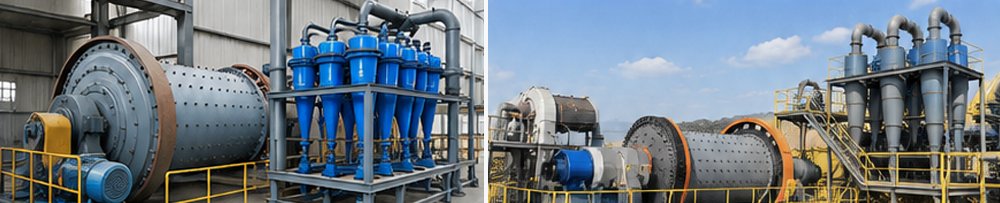
Optimizing the grinding and classification process requires a holistic view of feed particle size, feed rate, slurry concentration, ball mill operating status, and cyclone pressure; this makes it easier to identify the root causes affecting throughput and product particle size.
How do you choose between open-circuit and closed-circuit grinding?
| Comparison Criteria | Open-circuit grinding | Closed-circuit grinding (ball mill + hydrocyclone) |
| Flowsheet | Simple | Relatively complex |
| Number of equipment units | Fewer | More |
| Particle size control | Relatively limited | Easier to control |
| Over-grinding control | More difficult | Properly sized fines can be discharged promptly |
| Application scenarios | Coarse grinding or applications with low particle size requirements | Mineral processing flowsheet requiring precise product particle size |
| Automation | Relatively simple | Higher control requirements |
If the project has specific requirements for the particle size of the ground product—particularly when downstream processing stages such as flotation are involved—a closed-circuit grinding setup utilizing a ball mill and a hydrocyclone is usually the preferred option.
What is the difference between a hydrocyclone and a spiral classifier?
Both hydrocyclones and spiral classifiers can be used for grinding and classification, but they differ in their operating principles and suitable applications. Simply put, hydrocyclones are more compact and offer faster classification speeds, whereas spiral classifiers have a relatively simple structure and are better suited for certain traditional grinding circuits.
| Comparison Item | Hydrocyclone | Spiral Classifier |
| Classification Principle | Separates coarse and fine particles using centrifugal force | Classifies based on differences in settling velocity |
| Equipment Footprint | Small | Large |
| Classification Efficiency | Generally high | Relatively low |
| Fine Particle Classification | Better suited for fine particles | Better suited for coarser particles |
| Moving Parts | No mechanical rotating parts | Continuously rotating spiral |
| Key Maintenance Areas | Pump, cyclone liner, apex (underflow nozzle), etc. | Spiral flights, bearings, tank body, etc. |
| Energy Consumption Characteristics | Primarily from the slurry pump | Primarily from the spiral drive mechanism |
| Common Applications | Ball mill closed-circuit grinding, fine particle classification | Ball mill closed-circuit grinding, ore washing, and coarse particle classification |
Which one should you choose?
If your project requires finer classification, a compact equipment footprint, and integration with a ball mill to form an efficient closed-circuit grinding system, a hydrocyclone is generally the preferred option.
If the project prioritizes simplicity in structure, ease of operation and maintenance, and a relatively coarser classification size, a spiral classifier may be a suitable choice.
However, the final decision should not be based solely on the equipment itself; it must be determined by comprehensively considering factors such as ore characteristics, processing capacity, target particle size, slurry concentration, and the parameters of the existing ball mill.
Frequently Asked Questions
Q: Why is the hydrocyclone overflow particle size too coarse?
A: Possible causes include insufficient feed pressure, fluctuations in slurry concentration, cyclone wear, or mismatched equipment selection; a step-by-step check based on on-site parameters is required.
Q: Why does the hydrocyclone underflow exhibit a “roping” discharge pattern?
A: Common causes include underflow orifice blockage, excessively high slurry concentration, or abnormal feed pressure.
Q: Why has the ball mill’s throughput decreased?
A: In addition to the ball mill itself, check whether the cyclone circulating load is too high and whether the upstream crushing and feeding processes are stable.
Q: Why is the closed-circuit circulating load excessive?
A: This usually indicates that a significant amount of coarse particles is not being discharged via the cyclone overflow in a timely manner; the cyclone’s classification efficiency and operating parameters need to be checked.
Q: Why does the slurry concentration fluctuate frequently?
A: Instability in feed rate, make-up water addition, or production operations can all cause changes in slurry concentration.
Q: Why is the cyclone feed pressure unstable?
A: Check for slurry pump wear, pipeline blockages, and valve regulation issues.
Q: Why is the ball mill prone to over-grinding?
A: If properly sized fine material is not discharged via the cyclone overflow in time, it may repeatedly re-enter the ball mill for further grinding.
Q: Does cyclone wear affect classification performance?
A: Yes. Long-term erosion of the underflow orifice, overflow pipe, and liners by the slurry alters classification performance.
Q: Why is the final product particle size unstable?
A: A comprehensive check of the feed-to-mill particle size, feed rate, slurry concentration, ball mill operating status, and cyclone parameters is required.
Q: How should the ball mill and hydrocyclone be matched?
A: Do not rely solely on the throughput of individual units; matching should be based on a holistic assessment of ore properties, feed-to-mill particle size, target fineness, slurry concentration, and circulating load.
Q: Can the hydrocyclone be directly connected to the ball mill?
A: Yes, but a slurry pump is usually required to stably transport the slurry discharged from the ball mill to the cyclone. The underflow from the hydrocyclone is returned to the ball mill, forming a closed-circuit loop.
Q: How is the matching relationship between the ball mill and the hydrocyclone determined?
A: It requires simultaneous consideration of the ball mill’s throughput, feed particle size, ore grindability, target product particle size, slurry concentration, and the hydrocyclone’s processing capacity; one cannot rely solely on the parameters of a single piece of equipment.
Q: Why do coarse particles appear in the hydrocyclone overflow?
A: Common causes include unstable feed pressure, fluctuations in slurry concentration, abnormalities at the underflow discharge, equipment wear, and a mismatch between the model and operating conditions.
Q: Why does the hydrocyclone underflow sometimes discharge as a “rope” (rope discharge)?
A: This may be related to underflow discharge blockage, excessively high slurry concentration, fluctuations in feed pressure, or equipment wear; further assessment based on actual on-site operating conditions is required.
Q: Is closed-circuit operation involving a ball mill and a hydrocyclone always superior?
A: Not necessarily. The decision to use a closed-circuit grinding process depends on factors such as the target particle size, ore characteristics, throughput, and downstream beneficiation processes. However, closed-circuit systems generally offer advantages for grinding processes that require strict control over product particle size.
Conclusion
The process design for a ball mill and hydrocyclone circuit is not merely about connecting the two pieces of equipment in series; the core objective is to establish a stable balance among grinding, classification, circulating load, and target particle size.
If you are currently designing or retrofitting a grinding circuit, please contact CHUNLEI’s engineers. We will design an optimal circuit configuration based on factors such as feed particle size, ore hardness (or grindability), throughput, target fineness, and existing equipment specifications.
Latest News

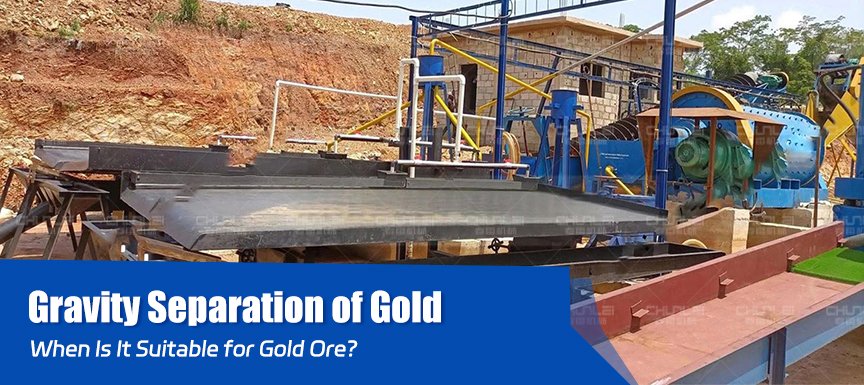
Gravity Separation for Gold: When Is It Suitable for Gold Ore?
800Many people immediately associate “gold ore” with gravity separation, yet not all gold deposits are suitable for recovery using gravity methods alone. Gravity separation is appropriate for liberated native gold or other heavy minerals that ex…
-
How Classification Affects Gold Grinding Efficiency
800In gold ore grinding circuits, attention is often focused primarily on ball mill capacity, power consumption, and grinding media; however, in actual operation, classification plays an equally critical role in determining grinding efficiency. …
-
Gold Ore Crushing and Grinding: What Equipment Do You Need?
800When designing a gold ore processing line, my clients often ask which crushers and mills to purchase. However, the equipment selection should actually be based on a thorough understanding of the ore characteristics. Issues in many projects do…
-
How to Select the Right Gold Processing Plant for Your Ore
800When selecting a gold processing plant, simply assuming that a full suite of equipment is all that is needed can lead to issues such as low recovery rates, high energy consumption, and failure to meet production targets.Different ores require d…
loading…
已经是到最后一篇内容了!