 Chunlei Mining Machinery
How does feed particle size affect the processing capacity and energy consumption of a ball mill?
In grinding workshops, ball mills are the core equipment with the highest energy consumption in the entire production line. Sometimes, high power consumption is not necessarily due to problems with the liner and steel ball configuration, but may be caused by uneven feed particle size.
Many customers have two extreme misconceptions:
- They believe that the finer the feed, the higher the mill output, thus reducing the crusher discharge port, leading to increased crushing wear and the generation of a large amount of ineffective fine powder;
- They neglect crusher and screening maintenance, allowing large pieces of material to enter the mill, causing additional crushing and increased power consumption.
Uneven feed particle size is a “hidden killer” affecting production capacity. Wear on crusher liners, broken screen mesh, or slag buildup in the ore bin can cause inconsistent feed coarseness, directly disrupting the slurry concentration inside the mill and the sediment circulation of the classifier/cyclone, causing the entire mill flotation system to malfunction.
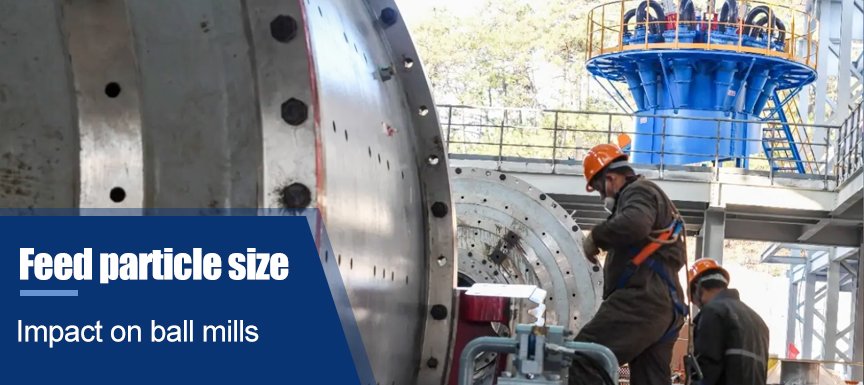
Why is the feed particle size so critical for ball mills?
The feed size for ball mills isn’t determined by the maximum feed diameter, but by three sets of indicators:
- Maximum Feed Size: The largest single particle size allowed to enter the mill;
- F80 Feed Size: The screen aperture size through which 80% of the mass of the feed material can pass, a standard industry benchmark for calculating grinding load;
- Feed Size Distribution (PSD): The mass distribution curve of the material across all particle sizes, determining the actual crushing workload inside the mill.
For example, two concentrators use the same 20mm feed control point, but at plant A, 35% of the particles are 15-20mm coarse particles, while at plant B, only 10% are 15-20mm, with the majority being fine particles <8mm. Although the “maximum particle size” appears the same, the actual grinding wear of the ball mill at plant A is far greater than that at plant B.
The more coarse particles inside the ball mill, the more times the steel balls need to impact the mill. If there is too much coarse material, the residence time of the material in the mill will be prolonged, which will directly lead to the inability to increase the new feed rate.
How does feed particle size affect processing capacity and power consumption per ton?
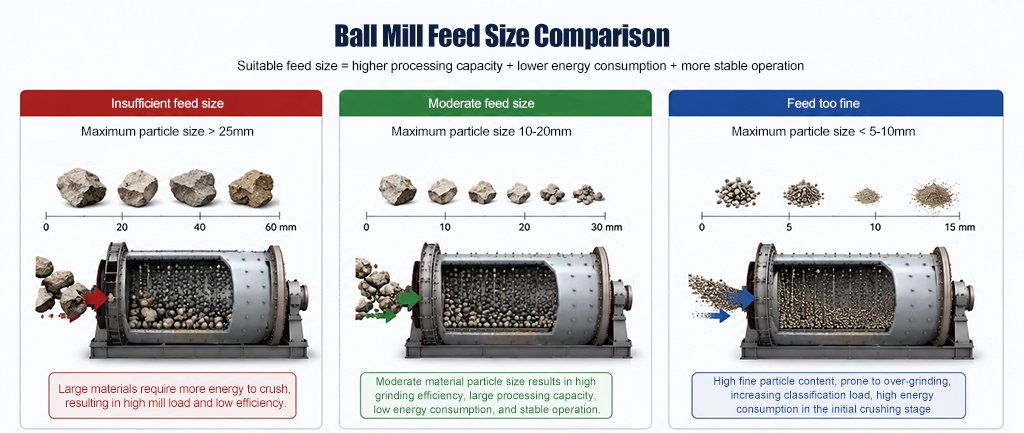
The feed particle size of a ball mill has a significant impact on both processing capacity and power consumption. However, finer feed doesn’t necessarily mean lower power consumption; a suitable range for ore properties and output particle size must be found.
| Feed Particle Size | Impact on Processing Capacity | Impact on Power Consumption per Ton |
| Too coarse feed | Increased crushing and grinding load, potentially decreasing throughput | Generally, power consumption increases |
| Moderately suitable particle size | Stable grinding efficiency, good processing capacity | Reasonable unit power consumption |
| Too fine feed | Reduced subsequent grinding load, but excessive crushing increases upstream energy consumption | Power consumption per ton of ball mill may decrease, but the total power consumption of the entire production line may not necessarily decrease. |
Why is feed particle size important?
Ball mills are primarily responsible for further grinding and liberating minerals. If the ore fed into the mill is too coarse, the ball mill needs to consume additional energy for crushing, leading to reduced throughput and increased steel ball consumption.
Adding jaw crushers, cone crushers, or other equipment before the ball mill can reduce the coarse crushing workload of the ball mill.
When selecting a ball mill, CHUNLEI considers these parameters together, rather than simply configuring equipment based on output.
How does feed particle size affect processing capacity and power consumption per ton?
There is no fixed feed size for a ball mill. The optimal feed particle size typically depends on the ore hardness, the ball mill specifications, the initial crushing capacity, and the desired final grinding fineness.
The optimal feed particle size can be determined by considering the following parameters:
| Ball Mill Applications | Common Feed Size Reference |
| Ordinary Ore Ball Milling | ≤15–25 mm |
| Harder Ore | ≤10–20 mm |
| Previously Crushed Ore | ≤10 mm |
Generally, controlling the feed particle size within approximately 10–20 mm can achieve stable grinding results.
More importantly, consider the F80 (80% of the material passing through the mill), rather than just the maximum particle size.
A truly reasonable feed particle size achieves a balance between crushing costs and ball mill power consumption. If you tell us the ore properties, throughput, and target fineness, CHUNLEI can further help you determine the appropriate feed particle size and ball mill configuration.
When should the pre-grinding system be optimized?
If a ball mill experiences issues such as insufficient throughput, high power consumption per ton, or large fluctuations in feed particle size, it’s not necessarily a problem with the ball mill itself. Often, the upstream crushing system should be checked first.
Typical situations include:
| On-site performance | Does the crushing system need optimization? |
| The feed ore particle size is frequently too coarse. | Yes |
| The ball mill is consistently operating at full capacity but output is low. | Yes |
| The ball mill’s power consumption per ton is consistently high. | Yes |
| The crushed product particle size fluctuates significantly. | Yes |
| The crusher frequently clogs or shuts down. | Yes |
| There is a large buffer inventory in front of the ball mill. | Assessable |
| The crushing system capacity is significantly lower than that of the ball mill. | Optimization recommended |
If your ball mill’s output consistently fails to meet design specifications, first review the most recent data on feed particle size, ball mill throughput, power consumption per ton, and crushing system operation. This will usually help you identify the problem more easily than simply replacing the ball mill.
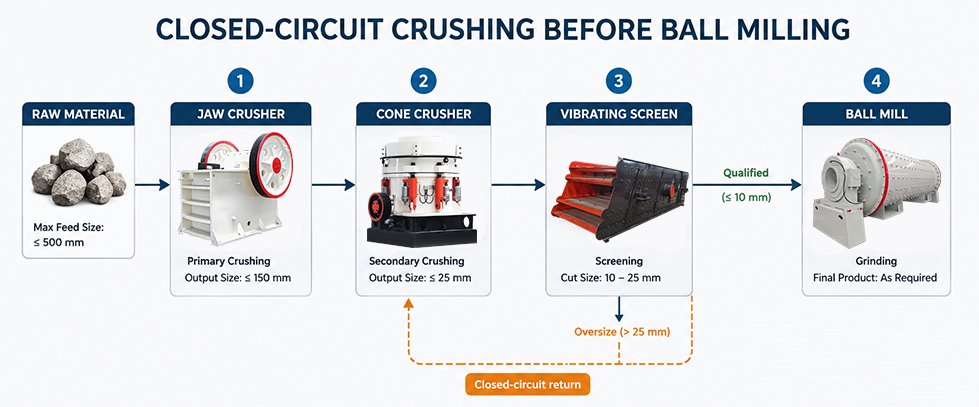
What other on-site variables can interfere with particle size optimization?
In actual optimization, simply changing the feed particle size often doesn’t produce the expected results. This is because the ball mill system is deeply coupled with multiple variables:
- Ore Hardness: Higher hardness typically requires more grinding energy; the same feed particle size may result in different processing capacities.
- Ore Grindability: Different ores have significantly different grindability; grinding load cannot be determined solely based on particle size.
- Feed Rate: Excessive feed can increase the ball mill load, while insufficient feed may lead to underutilization of equipment capacity.
- Feed Moisture Content: Changes in moisture content affect slurry flowability and grinding efficiency.
- Slurry Concentration: Excessive concentration may affect discharge and grinding efficiency, while insufficient concentration may reduce grinding effectiveness.
- Steel Ball Gradation: An unreasonable steel ball size and ratio, even with appropriate feed particle size, may result in poor grinding performance.
- Steel Ball Filling Rate: Directly affects the impact and grinding capacity inside the ball mill.
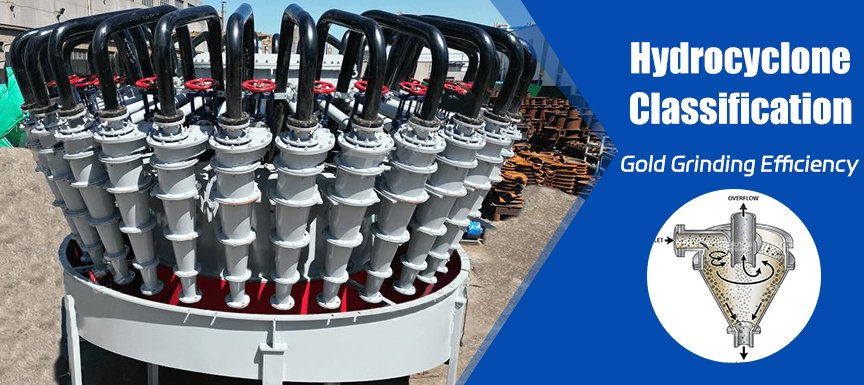
- Classification Efficiency: Low efficiency of hydrocyclones prevents timely discharge of qualified fine materials, easily leading to over-grinding.
- Circulating Load: Variations in circulating load affect the actual throughput and operating status of the ball mill.
- Target Product Particle Size: The desired final fineness directly impacts the required grinding energy.
- Feed Particle Size Fluctuation: Even with a suitable average particle size, significant variations in coarseness can still cause unstable operation of the ball mill.
- Actual Equipment Condition: Wear or malfunctions in liners, steel balls, and discharge devices can also affect grinding efficiency.
Optimizing the feed particle size requires more than just a single number. It necessitates considering the ore properties, crushing system, ball mill, classification equipment, and target fineness together to truly reduce the overall energy consumption of the grinding circuit.
How to optimize feed particle size without over-grinding?
Optimizing feed particle size is not simply about pursuing “the finer the better.” Excessive crushing at the front end not only increases power consumption in the crushing section but may also prematurely over-grind some minerals, affecting subsequent separation.
In practice, you can start from the following aspects:
- First, determine the target grinding fineness: This should be determined based on the requirements of subsequent flotation, gravity separation, and other processes, rather than simply pursuing a smaller feed particle size.
- Control the particle size distribution of the crushed product: Focus on F80, maximum particle size, and the proportion of fine particles, avoiding focusing solely on the maximum particle size.
- Avoid over-grinding at the front end: If the ball mill can already efficiently process a certain particle size, there is no need to increase crushing energy consumption to pursue a finer feed.
- Improve screening efficiency: Screen out qualified fine materials promptly to reduce their repeated entry into the crusher.
- Optimize crushing equipment: Select jaw crushers, cone crushers, etc., based on the ore hardness and target particle size to avoid long-term overload operation of the crushing section.
- Observe the actual performance of the ball mill: After adjustments, focus on comparing throughput, power consumption per ton, grinding fineness, and classification efficiency, rather than just looking at whether the feed particle size has decreased.
For specific projects, it is best to make judgments based on ore grindability, F80, target fineness, and existing crushing equipment operating data.
Frequently Asked Questions
Q1: Is a finer feed particle size always better for a ball mill?
A: No. An excessively fine feed particle size means the upstream crushing system is under excessive crushing load, leading to a surge in crusher power consumption, accelerated liner wear, and potentially the generation of large amounts of useless dust or over-crushed sludge. The optimal particle size is the balance point that minimizes the overall cost of crushing and grinding.
Q2: When the feed becomes coarser, will simply replacing the steel balls with larger ones solve the problem?
A: It can alleviate the problem of coarse particle breakthrough, but it’s not a long-term solution. Increasing the ball diameter reduces the total number of steel balls and the total grinding contact area in the cylinder, potentially leading to insufficient grinding of medium and fine particles, resulting in coarser overflow P80 or a surge in backflow sand.
Q3: Why haven’t some beneficiation plants increased ball mill output even after reducing the feed particle size?
A: Usually, it is because the closed-circuit classification system has a bottleneck (such as a clogged hydrocyclone underrunner, unstable feed pressure, or unreasonable slurry concentration). The qualified fine particles cannot be classified out in time, resulting in secondary grinding in the mill, which negates the advantages brought by the finer particle size.
Conclusion
Feed particle size directly affects the processing capacity and power consumption of a ball mill. Excessively coarse particles increase the mill load; excessively fine particles may increase energy consumption in the upstream crushing stage.
Therefore, the optimal approach is to determine the appropriate feed particle size based on the ore properties, throughput, and target fineness.
If your ball mill is experiencing low output, high power consumption per ton, or unstable feed particle size, please contact CHUNLEI. Provide your ore and production parameters, and we can help you analyze your crushing and grinding system and develop a more suitable solution.
Latest News

Gravity Separation for Gold: When Is It Suitable for Gold Ore?
800Many people immediately associate “gold ore” with gravity separation, yet not all gold deposits are suitable for recovery using gravity methods alone. Gravity separation is appropriate for liberated native gold or other heavy minerals that ex…
-
How Classification Affects Gold Grinding Efficiency
800In gold ore grinding circuits, attention is often focused primarily on ball mill capacity, power consumption, and grinding media; however, in actual operation, classification plays an equally critical role in determining grinding efficiency. …
-
Gold Ore Crushing and Grinding: What Equipment Do You Need?
800When designing a gold ore processing line, my clients often ask which crushers and mills to purchase. However, the equipment selection should actually be based on a thorough understanding of the ore characteristics. Issues in many projects do…
-
How to Select the Right Gold Processing Plant for Your Ore
800When selecting a gold processing plant, simply assuming that a full suite of equipment is all that is needed can lead to issues such as low recovery rates, high energy consumption, and failure to meet production targets.Different ores require d…
loading…
已经是到最后一篇内容了!