 Chunlei Mining Machinery
Improving Gold Recovery Rates: African Gold Mine Beneficiation Technology
Africa is one of the world’s richest gold-producing regions, with countries like Ghana, Mali, Tanzania, Sudan, Zimbabwe, and South Africa possessing abundant gold resources.
For gold mine investors, discovering a ore body is only the beginning. Even with ore of the same gold content, different beneficiation processes can result in significantly different amounts of gold that can be recovered. Therefore, the gold recovery rate is a crucial factor determining economic viability.
Improving gold recovery rates is not simply about adding more equipment; it requires designing a suitable beneficiation process based on the characteristics of the ore.
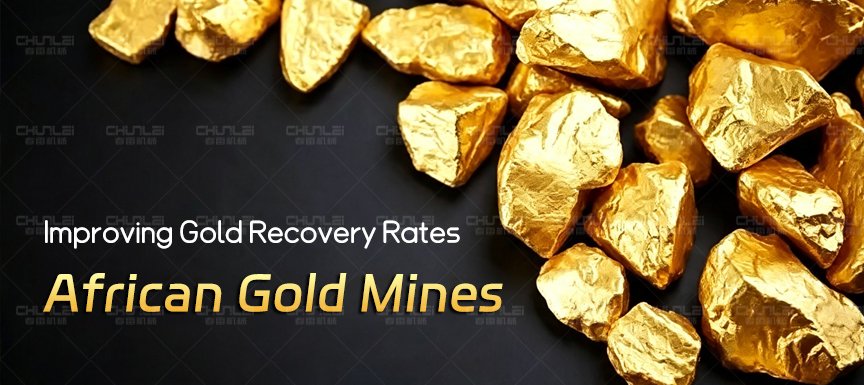
The Current State of the African Gold Market in 2026
International gold prices have continued to rise in recent years, and by mid-2026, gold was expected to remain stable above $2,650 per ounce. Africa, as the world’s highest gold-producing continent, remains highly sought after by gold mining investors.
- Ghana: Known as the “Gold Coast,” the gold industry accounts for 95% of the country’s mining tax revenue. Its mineral resources are mainly shallow placer gold and weathered oxidized gold.
- Mali: The third largest gold producer in West Africa, with abundant distribution of both oxidized and sulfide ores.
- Burkina Faso: Its gold industry is developing rapidly. At the end of 2023, its first gold refinery was completed, with an annual refining capacity of 150 tons, marking a milestone in local mining infrastructure.
- South Africa: Home to the Witwatersrand Gold Belt, including the world’s deepest Mbonig and South Deep gold mines, its ore is mainly sulfide gold.
African governments are strongly supporting local ore processing, and more and more mine owners are building their own processing plants to reduce transportation costs and improve overall gold recovery rates.
The Most Widely Distributed Gold Deposits in Africa
Africa is a major global gold-producing region. Due to significant differences in geological conditions across different areas, there are a wide variety of gold deposit types.
Place Gold / Alluvial Place Gold
- Distribution: Niger River Basin, Nigeria, Ghana, Tanzania
- Ore Characteristics: Gold is completely liberated from the sand and gravel; granular free gold (0–3 mm), mixed with clay and sand, without sulfide mineral inclusions;
- Benefits: No grinding required; gravity separation alone can recover 85%–95% of the individual gold.
Weathered Oxidized Rock Gold
- Distribution: Shallow open-pit mines in Burkina Faso, Tanzania, and northern Ghana
- Ore Characteristics: Weathered quartz ore; fine-grained gold; low sulfur content; no pyrite inclusions;
- Benefits: Combined recovery rate of 92%–97% after grinding, gravity separation, and carbon leaching.
Complex Sulfide Rock Gold
- Distribution: Deep vein-like mines in South Africa and Mali
- Ore characteristics: Gold is encased within sulfide minerals such as pyrite and galena; simple gravity separation and carbon leaching are ineffective for gold extraction;
- Standard process: First, flotation produces gold-sulfur concentrate, then the concentrate is cyanided and leached. Without pre-oxidation treatment, the overall recovery rate is only 72%–78%.
Why are gold recovery rates unsatisfactory in many African gold mining projects?
1. Insufficient Gold Liberation
In many lode gold deposits, gold is encased in other minerals. If grinding is insufficient, gold particles cannot be released, making subsequent gravity separation or flotation difficult to recover effectively.
2. Mismatch between Beneficiation Process and Ore Properties
Different types of gold ores require different processing methods. Some are suitable for gravity separation, some for flotation, and some require more complex processes. Applying other mining processes directly without ore testing can easily lead to a decrease in recovery rates.
3. Inadequate Equipment Matching
Gold beneficiation is a continuous, interconnected process. Insufficient crushing capacity affects grinding; unsuitable grinding fineness affects gold release; poor classification reduces subsequent beneficiation efficiency. Therefore, improving recovery rates requires optimizing the entire production process.
Detailed Explanation of 4 Gold Ore Beneficiation Processes
1. Pure Gravity Separation Process (Jig + Shaking Table / Centrifugal Concentrator)
Gravity separation is suitable for placer gold and coarse-grained free gold oxide. It requires no reagent consumption, relying on water flow stratification for physical separation, resulting in a short payback period and easy operation. Core equipment: drum washer, vibrating feeder, jig, spiral sluice, shaking table.
2. Flotation Process
Flotation is suitable for pyrite-encased sulfide gold ore and polymetallic gold ore with copper, lead, and zinc inclusions. Reagents are added to allow the gold-bearing sulfide ore to float to the surface with foam, separating waste rock. It can effectively recover fine sulfide gold, producing high-grade gold concentrate. Core equipment: jaw crusher, cone crusher, overflow ball mill, spiral classifier, flotation machine, thickener, filter press.
3. CIL/CIP Gold Extraction Process
This process is suitable for fine-grained, non-sulfide-containing gold oxide ore. Cyanide solution dissolves fine gold particles, while coconut shell activated carbon adsorbs the dissolved gold in the slurry. The combined recovery rate of this single process can reach 90%–97%, the highest among the four processes. Core equipment: jaw crusher, ball mill, hydrocyclone, leaching tank, desorption electrolysis system.
4. Gravity Separation + Carbon-Leaching Combined Process (Mainstream Solution for Medium-Sized Mines in Africa)
First, gravity separation is used to recover coarse free gold particles, and then the tailings are fed into carbon leaching to recover fine gold particles. Suitable for mixed oxide ores containing both coarse and fine gold particles (widely used in medium-sized mines in Tanzania and Mali). This combined process balances recovery rate and reagent consumption, with lower operating costs than a single all-carbon-leaching production line.
Real mining site cases in Africa
Case 1: South Africa 800 tons/day sulfide rock gold flotation plant
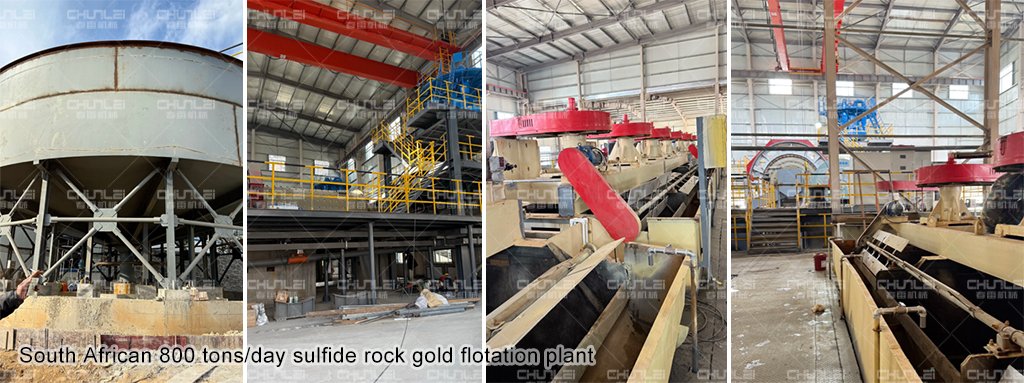
Project basic information:
- Origin: Witwatersrand gold belt
- Daily processing capacity: 800 tons
- Raw ore: deep vein sulfide gold ore
- Maximum feeding: 400mm
- Target comprehensive recovery rate: 75%
Full equipment list:
| Equipment Name | Model | Quantity |
| Jaw Crusher | PE600×900 | 1 unit |
| Cone Crusher | SC250 | 1 unit |
| Overflow Ball Mill | Φ2700×4500 | 2 unit |
| SF Flotation Machine | SF-8 | 6 unit |
Complete Mineral Processing Flow:
- Two-stage closed-circuit crushing: Large pieces of raw ore are fed into a jaw crusher for primary crushing, followed by a cone crusher for secondary crushing, and then a vibrating screen for classification. Large pieces are returned to the heavy crusher.
- Closed-circuit grinding: The crushed ore is fed into an overflow ball mill, coupled with a spiral classifier. Coarse sand is returned to the mill, achieving a fineness of 180 mesh or higher.
- Flotation separation: Reagents are added. Gold-bearing sulfide ore floats to form froth concentrate, while gangue sinks to become tailings.
- Concentration and dewatering: The flotation froth is fed into a thickener for dewatering, and then filtered to produce dry gold concentrate, which is sold to smelters.
Case 2: Nigeria 50 tons/hour placer gold gravity separation production line
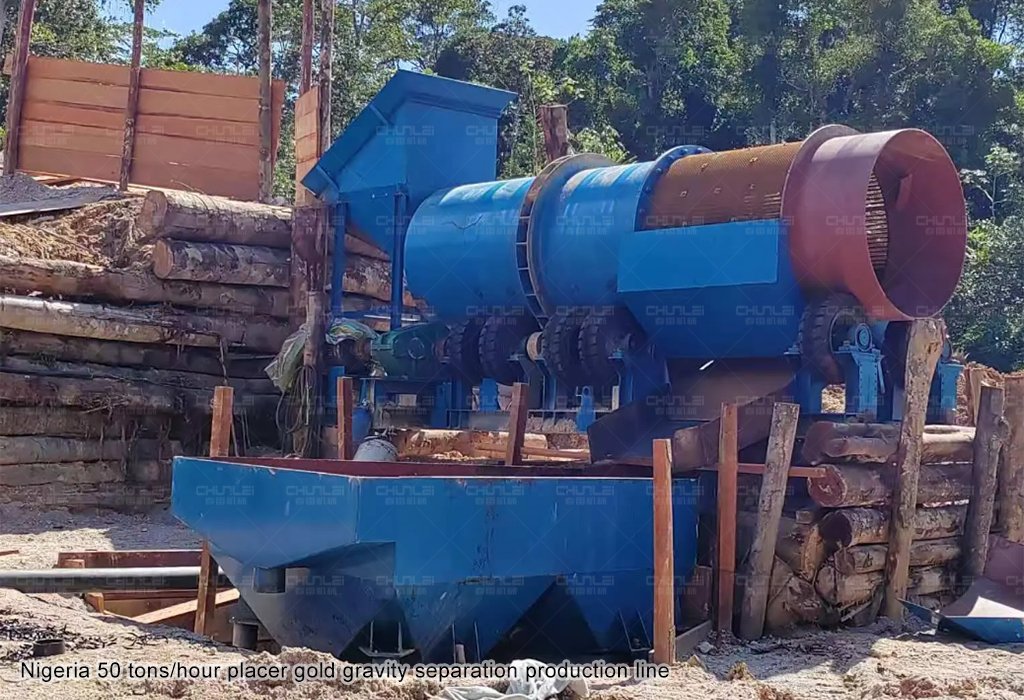
Project basic information:
- Origin: Niger River Basin
- Hourly Processing Capacity: 50 tons
- Ore: Loose sand and gravel, free gold 0–3mm, high clay content
- Process: All-physical gravity separation, no reagents
Benefiting Process:
- Washing and Desliming: Vibrating feeder evenly feeds the material to a drum screen. High-pressure water washes away the clay, fine mud is discharged through the screen, and large stones are fed to the rear end;
- Roughing Separation: The undersize slurry is fed to a jig to recover medium and coarse gold particles;
- Cleaning and Purification: The jig concentrate is fed to a shaking table for separation, producing high-grade gold placer.
Process Summary:
The drum washing machine is suitable for placer gold in high-muddy riverbeds. The equipment is simple and has low operation and maintenance costs. Due to the large density differences among individual gold particles, the combination of jigging and shaking tables can achieve a free gold recovery rate of up to 91%.
Case 3: Tanzania 10 Tons/Day Small-Scale Oxide Rock Gold Gravity Separation Plant
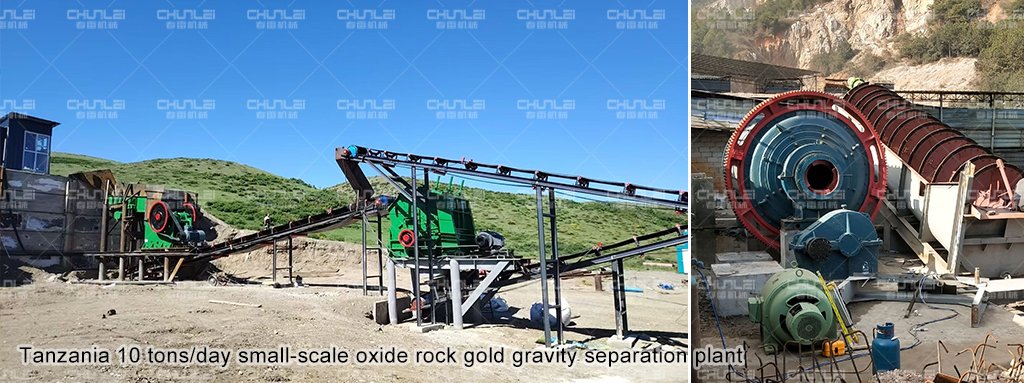
Project basic information:
- Origin: Open-pit mine in central Tanzania
- Daily Processing: 10 tons
- Ore: Fine-grained free gold, without sulfide inclusions
- Process: Crushing + Ball Milling + Shaking Table Gravity Separation, Free Gold Recovery Rate 97%
Process Steps:
- Two-stage crushing: Jaw crusher for coarse crushing + hammer crusher for fine crushing;
- Grinding and liberation: The ore is fed into a ball mill to completely liberate the gold from the quartz;
- Shaking table separation: The milled slurry is fed into a shaking table to directly produce high-grade gold concentrate.
A comprehensive comparison of four mineral processing technologies
| Comparison Dimensions | Pure Gravity Separation Process | Single Flotation Process | Single CIL Carbon-Leaching Process | Gravity Separation + Carbon-Leaching Combined Process |
| Core Compatible Ores | Plain Placer Gold, Coarse-Grained Free Oxidized Ores | Pyrite-Encased Sulfide Gold Deposits, Associated Polymetallic Gold Deposits | Fine-Grained Non-Sulfide Oxidized Rock Gold Deposits | Mixed Coarse and Fine Oxidized Gold Deposits (Crude Gold + (Coexistence of fine gold particles) |
| Gold Overall Recovery Rate | 85%–91% | 72%–78%(Concentrate Grade) | 92%–97% | 90%–95% |
| Reagent Consumption Cost | Zero reagents | Medium (Collectors, frothers, modifiers) | High (Cyanide, activated carbon, alkali) | Medium (Carbon leaching stage reagents, higher specific gravity separation, lower than pure carbon leaching) |
| Water and Electricity Consumption | Low | Medium | High | Medium |
| Core Equipment | Drum Washing Machine, Jig, Shaking Table, Spiral Sluice | Jaw Crusher, Ball Mill, Flotation Machine, Thickener, Filter Press | Jaw Crusher, Ball Mill, Leaching Tank, Desorption Electrolysis System | Jig/Shaking Table + Ball Mill + Carbon Leaching Tank |
| Plant Investment Scale | Small | Medium-Large | Large | Medium |
| Operating Difficulty | Extremely low, easy for local workers to learn | Medium, requires professional pharmacist for reagent preparation | High, requires cyanide safety management qualification | Medium-high |
| Environmental Requirements | No special requirements, physical separation | Tailles require treatment of reagent residues | Extremely strict, requires cyanide neutralization + tailings dam | Strict, requires supporting tailings harmless treatment |
| Typical Payback Period | 12–20 months | 24–36 months | Over 36 months | 24–30 months |
| Typical Applications in Africa | Nigeria, Ghana placer gold mines | South Africa, Mali deep sulfide mines | Ghana, Burkina Faso oxide mines | Tanzania, Mali medium-sized mixed mines |
How to Choose the Right Mineral Processing Technology for Your Ore?
Many clients have asked me, “What mineral processing method should I use for my ore?” The key is to consider the properties of the ore itself. Having manufactured mineral processing equipment for many years, our advice to clients is usually to consider three aspects:
First, consider the type of ore.
Different ores are suited to different mineral processing methods. For example, magnetite generally uses magnetic separation, gold ore commonly uses gravity separation, flotation, or leaching, while copper and lead-zinc ores often use flotation.
Second, consider the mineral distribution.
Some ores contain relatively large particles of valuable minerals that can be recovered after simple crushing; others have tightly bound minerals and impurities, requiring fine grinding followed by separation through flotation, magnetic separation, etc.
Third, consider the client’s production needs.
Besides improving recovery rates, investment costs, throughput, energy consumption, and ongoing maintenance must also be considered. A process suitable for a large mine may not be suitable for a small mine.
Therefore, choosing a mineral processing technology cannot be based solely on experience, nor can you simply copy someone else’s production line. A more reliable approach is to first conduct ore testing and beneficiation experiments, design the process flow based on the test results, and then select appropriate equipment.
This ensures a reasonable balance between ore recovery rate, production costs, and equipment investment.
FAQ
Q1: What is the difference between placer gold and lode gold beneficiation?
A: Placer gold has already been liberated from the sand and gravel, requiring only washing and gravity separation; grinding is not necessary. Lode gold, however, is encased within the rock, requiring crushing and grinding for liberation and separation.
Q2: Can gravity separation alone be used to extract gold from sulfide gold ore?
A: No, most of the gold is encased in pyrite, and gravity separation cannot recover the fine encapsulated gold; flotation enrichment is necessary first.
Q3: Is the cyanide-carbon leaching process permitted in Ghana and Mali?
A: It can be used under legal and compliant conditions, but it must be accompanied by complete cyanide neutralization and tailings dam facilities. Small-scale artisanal mines face strict restrictions.
Q4: What is the payback period for a 50 tons/hour placer gold gravity separation plant?
A: For West African riverbank mines with stable gold prices and normal ore grades, the payback period is 12–20 months.
Q5: Do you provide on-site installation and operator training in Africa?
A. We can dispatch professional mineral processing engineers to all African countries to complete equipment assembly, commissioning, and technical training for local workers.
Q6: What process should be used for low-grade weathered oxidized ore in Tanzania?
A. Gravity separation is used to recover crude gold first, followed by small-scale carbon leaching to process finer gold, balancing recovery rate and operating costs.
Q7: Do placer gold mines need ball mills for grinding?
A. No, grinding will crush crude gold into finer gold, which will actually reduce the gravity separation recovery rate.
Latest News

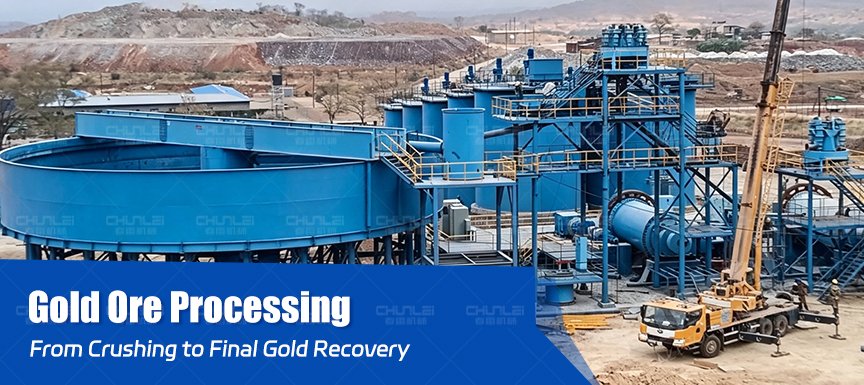
Gold Ore Processing: From Crushing to Final Gold Recovery
800A gold processing plant is not merely a simple assembly of crushers, ball mills, and gold recovery equipment; rather, the goal is to determine the optimal process flow based on factors such as mineral composition, gold particle size,…
-
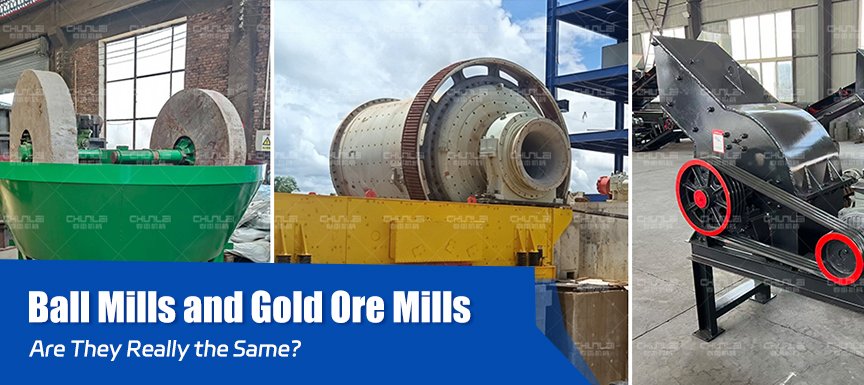
Ball Mills and Gold Ore Mills: Are They Really the Same?
800When searching for gold ore grinding equipment, customers often encounter various terms such as “Ball Mill,” “Gold Mill,” “Gold Milling Machine,” and “Gold Ore Grinding Machine.” Many buyers assume that a “Gold Mill” is a specialized mill de…
-
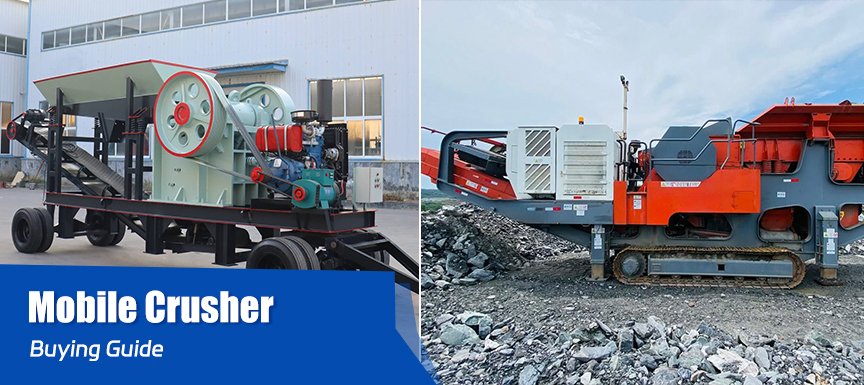
Mobile Crusher Buying Guide: Wheeled or Tracked?
800Many customers focus solely on portability when purchasing a mobile crusher, viewing it merely as the acquisition of a single piece of equipment. In reality, selecting the wrong model can lead to either insufficient output or excessive wear and…
-
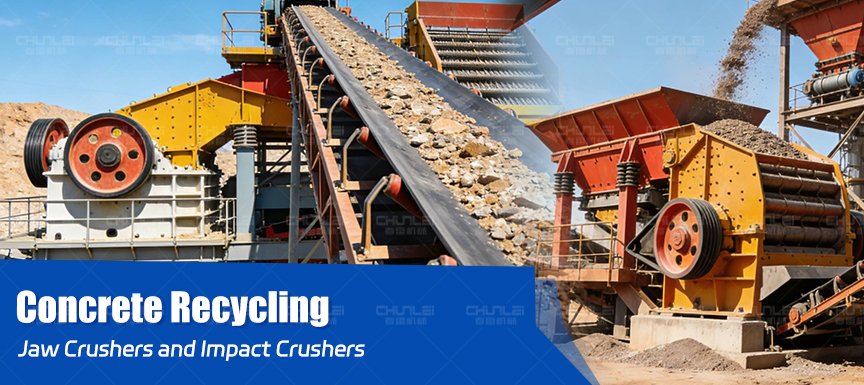
Jaw Crushers and Impact Crushers: Turnkey Solutions for Concrete Recycling
800Demolishing old buildings and roads generates vast amounts of waste concrete; direct landfilling not only consumes valuable space but also incurs high transportation costs. The real challenge lies in transforming this waste concrete into reusab…
loading…
已经是到最后一篇内容了!