 Chunlei Mining Machinery
2026 Ball Mill Prices and Buying Guide
Hammer Mills for Gold: Why Choosing the Wrong Equipment Can Affect Gold Recovery?
Hammer mills are highly popular among customers because of their relatively simple structure and ability to crush and finely grind gold ore within a compact process flow; however, they are not suitable for every type of gold ore.
Some gold ores contain significant amounts of hard, abrasive minerals—such as quartz—that drastically accelerate the wear on hammers and liners. An unsuitable choice of equipment can lead to issues such as rapid wear-part consumption, failure to meet production targets, or even insufficient liberation of the gold.
Grinding gold ore finer is not always better. If the grind is too coarse, gold particles may remain locked within the gangue; if it is too fine, excessive amounts of “slimes” (fine mud) may be produced, interfering with subsequent gravity separation. Therefore, when selecting a hammer mill, you must consider factors such as ore characteristics, feed size, required grind fineness, and the downstream recovery method (gravity separation, flotation, or leaching), rather than focusing solely on equipment price and production capacity.
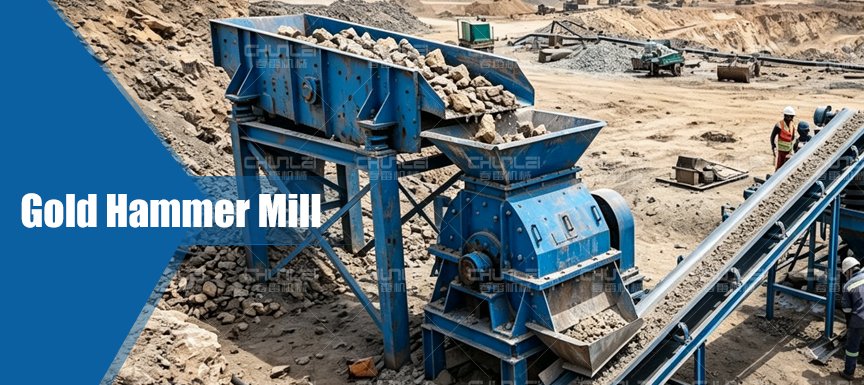
What is a gold hammer mill?
A gold hammer mill is a piece of equipment that uses the impact of high-speed rotating hammers to crush and finely grind gold-bearing ore.
The machine features a high-speed rotor equipped with multiple hammers. Once ore enters the crushing chamber, it is continuously broken down by the high-speed impact of the hammers, as well as through collisions and compression between the ore particles themselves. Material that meets the required particle size is discharged through a screen plate, while oversized material remains in the chamber for further crushing.
In gold processing, the purpose of a hammer mill goes beyond simply reducing the size of large ore chunks; more importantly:
It achieves effective particle size reduction to fully liberate gold particles encapsulated within the ore, thereby preparing the material for subsequent gravity separation, flotation, or leaching processes.
Are “hammer mill” and “hammer crusher” the same piece of equipment?
When searching for “Hammer Mill for Gold,” you will often encounter terms such as:
Gold Hammer Mill
Hammer Crusher
Hammer Mill Crusher
Gold Ore Hammer Mill
Terminology varies by manufacturer and region, and the specific modes of operation may also differ.
In small-scale gold mining projects, in particular, the hammer mill often handles both primary crushing and a certain degree of coarse grinding.
When purchasing, do not rely solely on the equipment name; instead, focus on verifying the following specifications:
Maximum feed size → Discharge particle size → Processing capacity → Ore hardness → Abrasiveness → Downstream beneficiation process
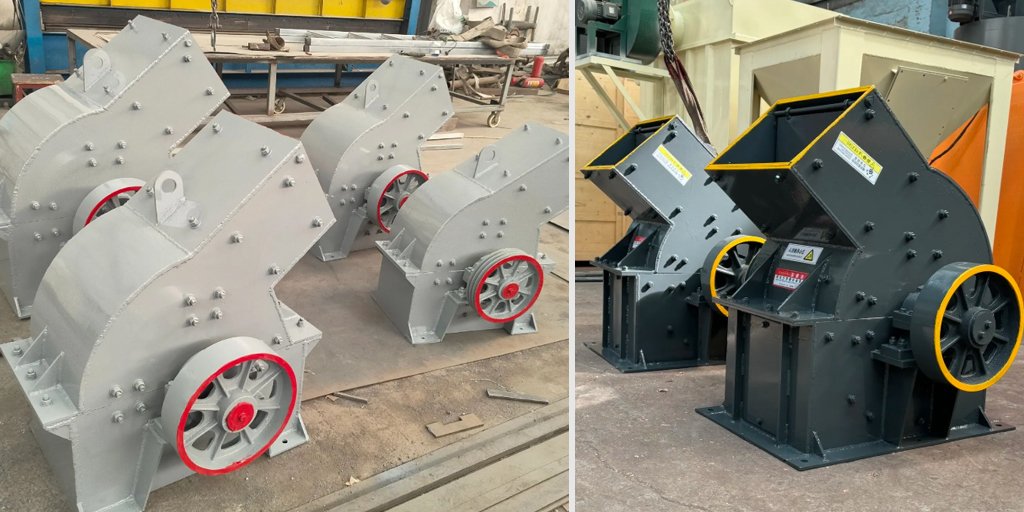
How does a gold ore hammer mill work?
A gold ore hammer mill primarily reduces ore particle size through the impact, collision, and grinding actions of high-speed rotating hammers. Simply put, after ore enters the crushing chamber through the feed inlet, it is subjected to continuous blows from the high-speed rotating hammers, causing it to break down. Larger particles remain in the chamber for repeated crushing and are discharged through a screen plate only after reaching the required particle size.
The specific process can be broken down as follows:
1. Feeding
Run-of-mine (ROM) ore first enters the hammer mill.
If the raw ore chunks are large, a jaw crusher is typically installed upstream to break the large ore down to a feed size suitable for the hammer mill.
Therefore, in a complete gold processing line, the jaw crusher and hammer mill work in tandem, avoiding the need for the hammer mill to process oversized raw ore directly.
2. High-speed impact crushing
Once the ore enters the crushing chamber, a high-speed rotating rotor drives the hammers to continuously strike the ore.
The ore breaks down gradually under continuous impact and undergoes repeated collisions within the chamber.
For gold-bearing ore, the key significance of this step is:
To gradually liberate gold particles from the ore matrix or gangue.
3. Screening and discharge
The screen plate controls the discharge particle size.
Material is discharged once it reaches the size required by the screen apertures; larger particles remain in the chamber for further crushing.
Generally, smaller screen apertures result in a finer product, but this can also lead to:
- Increased residence time inside the equipment
- Increased circulating load
- Higher energy consumption
- Accelerated wear on hammers and screen plates
- Therefore, smaller screen apertures are not necessarily better.
The truly appropriate particle size should be determined based on the gold liberation size and the subsequent recovery process.
4. Proceeding to gravity separation or other recovery stages
After processing in the hammer mill, the ore moves on to downstream recovery equipment.
For gold ores suitable for gravity separation, options include:
The specific equipment chosen depends on the mode of gold occurrence within the ore. There is a very important principle here:
For gold ore, finer is not necessarily better; rather, it should be ground to a particle size that ensures effective liberation and is suitable for subsequent recovery.
What types of gold ore are suitable for hammer mills?
Hammer mills are best suited for gold ores with low to medium hardness where gold particles dissociate easily. Caution should be exercised if the ore contains significant amounts of hard quartz or other highly abrasive minerals.
Suitable applications include:
- Weathered gold ore: The ore is relatively loose, making crushing easier.
- Oxidized gold ore: Partially oxidized ore often has lower hardness, making it suitable for hammer-impact crushing.
- Easily dissociable lode gold ore: Gold particles are released at coarser sizes, reducing the need for unnecessary fine grinding.
- Medium-hardness gold ore: Hammer mills can be considered if the equipment is configured with appropriate wear-resistant parts.
- Small-scale gold mining projects: Hammer mills offer advantages when the process is simple and equipment investment needs to be controlled.
Which gold ores require caution?
For hard lode gold ores with high quartz content and high abrasiveness, hammer heads and screen plates may wear out quickly. For such ores, it is usually necessary to compare alternatives like jaw crushers, cone crushers, and ball mills.
Selecting a hammer mill depends on ore hardness, quartz content, feed particle size, target discharge size, and gold dissociation characteristics. If you have gold ore samples or these basic parameters, please contact CHUNLEI, we can help you determine whether a hammer mill is the right choice.
How fine can a hammer mill grind gold ore?
The output particle size of a hammer mill is primarily determined by the screen plate aperture, rotor speed, ore hardness, and feed size. Generally, hammer mills suitable for gold ore can reduce material to the millimeter range, with some configurations achieving approximately 1–2 mm.
However, the specific fineness varies:
- 2–5 mm: Relatively common; suitable for the liberation of some coarse gold particles and subsequent gravity separation.
- 1–2 mm: Requires appropriate screen plates and operating parameters.
- Finer powders: Relying solely on a hammer mill is usually not recommended; specialized fine-grinding equipment, such as a ball mill, should be considered.
For gold ore, the focus should be on the liberation size of the gold particles rather than simply aiming for “the finer, the better.” If the gold is already well-liberated at around 1–2 mm, there is no need for further over-grinding.
When selecting equipment, it is best to provide the following details: maximum raw ore particle size, processing capacity, ore hardness, and target output particle size. Based on this information, we can help determine whether a hammer mill is suitable and whether it needs to be paired with a ball mill.
What are the differences between hammer mills, jaw crushers, and ball mills?
Although all three types of equipment can be used in gold ore processing, they perform different functions. The main differences lie in the crushing or grinding method, the feed particle size, and the final product particle size:
| Comparison Item | Hammer Mill | Jaw Crusher | Ball Mill |
| Primary Function | Crushing, fine crushing | Coarse crushing, primary crushing | Fine grinding, pulverizing |
| Working Mechanism | High-speed hammer impact on ore | Compression of ore between movable and fixed jaws | Impact and grinding of ore by steel balls |
| Suitable Feed | Small to medium-sized ore chunks | Large raw ore chunks | Previously crushed ore |
| Product Particle Size | Millimeter range (depends on screen plate) | Typically coarse crushed product | Can achieve finer ground product |
| Common Applications | Small/medium gold mines; soft to medium-hard ores | Primary coarse crushing for gold, copper, iron, etc. | Mineral processing requiring fine grinding (e.g., gold) |
| Key Advantages | Relatively simple structure; high reduction ratio | Handles large ore chunks; highly adaptable | Suitable for fine grinding and mineral liberation |
| Key Disadvantages | Rapid hammer wear with highly abrasive ores | Difficult to obtain very fine product when used alone | Higher investment and auxiliary system costs |
| Typical Position in Gold Mining | Further size reduction after coarse crushing | At the very beginning of the process | Fine grinding stage following crushing |
Can a hammer mill replace a ball mill?
Not necessarily; not all gold ores are suitable for this substitution. A hammer mill is the preferred choice if the ore has moderate hardness, the gold particles are easily liberated, and the required product fineness is not particularly high.
However, if the gold particles are finely disseminated and require grinding to a finer size for adequate liberation, a ball mill is the better option. When processing hard or highly abrasive gold ores, the wear on the hammer mill’s hammers is also a critical factor to consider.
Equipment selection should be based on ore characteristics and the target particle size; only then should you decide whether to use a hammer mill, a ball mill, or a combination of both.
Typical Process Flow for Gold Mine Hammer Mills
For certain small-to-medium-sized gold mines suitable for gravity separation, a relatively simple process flow can be adopted:
Run-of-mine ore → Jaw crusher → Hammer mill → Screening → Gravity separation → Gold concentrate
If finer grinding is required, the process can be extended as follows:
Run-of-mine ore → Jaw crusher → Hammer mill → Ball mill → Classification → Gravity separation / Flotation / Leaching
Detailed Process Description:
- Jaw crusher: Crushes large chunks of run-of-mine ore to a suitable particle size.
- Hammer mill: Further reduces ore particle size, achieving partial liberation of gold particles.
- Screening: Controls the discharge particle size; material meeting specifications proceeds to the next stage.
- Ball mill (optional): If gold particles are finely disseminated and further grinding is required, a ball mill can be added.
- Gravity gold separation: For ores suitable for gravity separation, equipment such as shaking tables, jigs, or centrifugal concentrators can be used to recover coarse gold particles.
Not all projects require the full configuration.
If the hammer mill can already process the ore to the appropriate liberation size, adding a ball mill might result in unnecessary investment.
Conversely, if the hammer mill cannot achieve the required liberation size, it should not be used simply to save on equipment investment.
How do you choose the right hammer mill for gold ore?
When selecting a hammer mill for gold ore, don’t rush to look at prices and models; first, clarify the ore characteristics and production requirements. Experienced sales professionals typically focus on the following parameters:
- Ore Hardness: Hammer mills are better suited for soft to medium-hard gold ores, such as quartz vein gold or oxidized gold ore; caution is advised for high-hardness or highly abrasive ores.
- Feed Size: Generally, rocks ≤200mm can be fed directly into a hammer mill. If the raw ore blocks are larger, a jaw crusher is usually required upstream; you should not force the hammer mill to process oversized ore chunks directly.
- Processing Capacity: Determine the required tonnage per hour and select equipment specifications based on actual operating conditions; do not blindly aim for maximum capacity.
- Discharge Size: Determine the required fineness for downstream processes—such as gravity separation or flotation—before selecting the appropriate screen plates and equipment.
- Gold Liberation: If gold particles can be liberated at coarser sizes, a hammer mill may suffice; if fine grinding is required, a ball mill should be considered.
- Downstream Processing: Clarify whether subsequent steps involve shaking tables, centrifugal concentrators, jigs, flotation, or leaching, as the hammer mill’s discharge size must meet the requirements of these downstream processes.
Selecting a gold ore hammer mill involves evaluating “ore properties + feed size + processing capacity + discharge size + downstream processes” as a whole. If you are still unsure about the selection, contact CHUNLEI, we can help you determine the suitable hammer mill model and configuration, preventing wasted investment from choosing equipment that is too large or failing to meet production targets with equipment that is too small.
Common Mistakes When Purchasing Gold Ore Hammer Mills
Mistake 1: Focusing solely on the equipment price
A low-priced hammer mill does not necessarily mean low operating costs.
If the hammers and screen plates wear out quickly, long-term costs may actually be higher.
Mistake 2: Ignoring ore abrasiveness
Gold ore with high quartz content can significantly accelerate equipment wear.
Before purchasing, you should clarify the materials used for the hammers, screen plates, and liners, as well as their replacement costs.
Mistake 3: Aiming for the finest possible output
Over-grinding can produce excessive fines (slimes), which are not necessarily beneficial for subsequent gravity separation.
Mistake 4: Relying solely on the manufacturer’s rated capacity
Capacity must be evaluated in conjunction with:
Feed size + Ore characteristics + Moisture content + Discharge size + Screen plate configuration.
Mistake 5: Feeding oversized raw ore into the hammer mill
If the raw ore chunks are too large, appropriate primary crushing equipment should be used first, rather than forcing the hammer mill to process oversized material.
Mistake 6: Ignoring downstream recovery processes
The ultimate goal of crushing and grinding is gold recovery.
If you focus only on the crushed particle size without considering subsequent gravity separation, flotation, or leaching, it is easy to select the wrong equipment.
When is a hammer mill the right choice?
You should seriously consider a hammer mill for gold if your project meets the following criteria:
- Small- to medium-scale gold mining project
- Moderate ore hardness
- Gold is relatively easy to liberate
- A simple crushing/grinding process is required
- Gravity separation is used for downstream processing
- Space constraints for equipment
- A desire to minimize the number of machines and the initial investment
However, if the ore is extremely hard and abrasive, or if a very fine grind size is required, it is recommended to compare this option against the traditional flowsheet of crushing, ball milling, and classification.
FAQ
Q1: Is a hammer mill suitable for gold ore?
Suitability depends primarily on the ore’s characteristics. Hammer mills may be considered for softer or medium-hard gold ores that are easy to liberate; however, for hard and highly abrasive ores, preliminary testing is recommended.
Q2: Can a hammer mill grind gold ore into a fine powder?
Hammer mills can reduce gold ore to a relatively fine particle size, but the specific fineness achievable depends on the equipment model, screen aperture, and ore properties. If a very fine liberation size is required, specialized grinding equipment—such as a ball mill—may still be necessary.
Q3: Can a hammer mill replace a jaw crusher?
In some small-scale projects, this may be an option depending on the feed size; however, if the raw ore consists of large lumps, a jaw crusher is generally still required for primary (coarse) crushing.
Q4: Can a hammer mill replace a ball mill?
Not necessarily. If the gold ore can be sufficiently liberated at a coarser particle size, a hammer mill may suffice; however, if the gold particles are finely disseminated, a ball mill may still be required.
Q5: How do I select a hammer mill for gold ore?
Focus on providing details regarding feed size, processing capacity, ore hardness, abrasiveness, target discharge size, and the downstream beneficiation method. These parameters are more important for model selection than relying solely on equipment price or advertised capacity.
Conclusion
For some small-to-medium-sized gold mining projects, a gold hammer mill can serve as a size-reduction solution featuring a relatively simple structure and a compact process flow. However, it is not a universal substitute for jaw crushers or ball mills.
Before purchasing, it is crucial to verify key parameters such as ore hardness, quartz content, feed size, processing capacity, discharge size, and the consumption rate of wear parts.
If you are evaluating a gold hammer mill, please contact CHUNLEI’s engineers. Based on your specific operating conditions, we will recommend the most suitable solution—whether it be a hammer mill, jaw crusher, or ball mill—to help you optimize your investment and minimize the risk of future retrofitting.
Latest News

A Comprehensive Guide to Types of Tin Ore and Mineral Processing Techniques
800Tin ore beneficiation is not merely a matter of crushing and grinding the ore before feeding it into a jig or a shaking table. Even within a single tin mining project, the optimal beneficiation process can vary significantly depending on factor…
-
How is a 0.2% tin ore processed into a 60% concentrate?
800Many clients attempt to process ore containing 0.2% tin, only to find that—after a series of operations—the ore grade has failed to improve, while significant amounts of cassiterite remain in the tailings. Some clients try to compensate by inte…
-
What are the gravity separation process flows for tin ore?
800Having worked in the tin mining industry for many years, I’ve observed a recurring issue among clients: even when the raw ore has a high tin content and a substantial amount of processing equipment is employed, the final tin recovery rates rema…
-
Gravity Concentration vs. Flotation for Gold: Which Process Should You Choose?
800In gold beneficiation projects, many mining engineers face a critical question: Why does the final gold recovery rate consistently fall short of expectations, even when grinding fineness and reagent regimes are strictly maintained according t…

loading…
已经是到最后一篇内容了!